• Home
  • Recipes
    • Vegetarian
    • Seafood
    • Snacks
    • Chicken
    • Mutton
    • Egg
    • Roti & Parathas
    • Dessert
    • Sides
    • Soups
    • Salad & Bowls
    • Rice
    • Daal
    • Bakes
    • Roasted
    • Beverages
    • Sauces, Spices & Curry Base
    • Chutney & Dips
    • Festive Recipes
  • Cuisine
    • Bengali
    • Maharashtrian
    • Rajasthan
    • Punjab
    • Chennai
    • Andhra
    • Mangalore
    • Mughlai
    • Kashmiri
    • Chinese
    • Singapore
    • Mexican
    • Continental
    • Italian
    • French
    • American
    • Thai
    • Bangladeshi
    • Arab & Persia
    • North East
  • Meal Type
    • Breakfast
    • Lunch
    • Dinner
    • Snacks
    • Dessert
    • Appetizer
    • Accompaniments
  • How To
    • Preservation Techniques
  • Travel
    • East India
    • West India
    • North India
    • South India
    • Asia
    • America
  • Lifestyle
    • Craft & Creation
    • Experiences
  • Musing
  • Contact
  • Bengali Blogs

Curries & Stories

pinterest facebook twitter instagram tumblr linkedin


Continued from Part 2.

 Day 4: Gangtok to Ravangla

“When the wind calls, you know, that somewhere in the mountains,
it has found the answers that you were looking for.
The pull of the horizon overcomes the inertia of reason…And you just have to go.”
(Vikram Oberoi)


We started for Ravangla at 10 Am next day after having a good breakfast. The two Nepali boys who served us during our stay in Green Park never displayed any facial expression to anything good or bad said to them. They were so quick with the food service that we hoped that it was not a couple of ghosts we were dealing with…you know like the ones we used to read as kids. While accepting the tip also it was the same expressionless face just a slight nod of the head. We had got used to it so we bade them goodbye and began our journey.

Sikkim is a place where you simply can’t come and say that you have seen it all. A few steps ahead, maybe just by the corner of the hairpin bend or by the side of the Dhupi tree an unassuming mountain waterfall might just surprise you.

For Ravangla we had to go from one mountain to another. It is 65 Kms from Gangtok. Ravangla is better known as Rabong locally. First we came down the mountain from Gangtok and then rose to almost 6000 feet with more dense forest and beautiful scenery along the way as we rose higher and higher. The temperature difference was remarkable as we came closer to Ravangla. On the way we stopped at a roadside food shack to freshen up and have some food. It was a pure Sikkimese thatched hut with 4 long tables, many chairs, a small counter and a TV playing Tom & Jerry. Most of the tables were occupied by local people enjoying a plate of momo or parathas while watching the cartoon. We shared a table with an old lady having her food. It was almost 12 PM and lunch time for them. We ordered Chicken Momo. Our driver also had his meal while we waited for our momo. It is a general observation all through our stay that local drivers would always take you to Sikkimese joints rather than the ones run by people from Bengal or elsewhere maybe because they only ate cuisine known to them and not rice and fish curry like most Bengalis do. This driver also told us stories that many people died or became possessed when they ate food at any random joints other than the ones which are “safe”. Well that didn’t scare us for sure.

Anyway when our momos arrived we noticed that it was not the one that others were having. When I asked this to the lady serving the food she said those were beef momos. The food was okayish nothing to compare with what we had at Chetris hotel.

The driver pointed to a hill top and informed us that it was the famous Temi Tea garden. Temi was not on our planned itinerary. We had decided that if we feel and time permits we will push that into our itinerary while travelling to Asangthang- the last destination of our trip. We had two sightseeing planned for the day in Ravangla.
Bridge for passing water pipe

We reached Ravangla at about 1 PM. Perched on a narrow ridge between the Meanam and Tendong hills at a height of 6800 ft, it’s a quaint idyllic town situated on either side of an L shaped road. Our Hotel Reegyal was at the town’s main traffic junction but we were going to check into the hotel once we completed the local sightseeing. We passed the hotel and main market area and drove towards the end of the city. From far we could see a huge golden Buddha statue against the landscape, it was the Buddha Park our driver informed.  It was pretty overcast that day and cold winds accompanied us everywhere. We crossed the Buddha park which looked very majestic against the clouds seeping down the hills and kept going upward. The driver cautioned us that the roads leading to Ralong Monastery were going to be bad. How bad – we discovered soon enough. 13kms from Ravangla, the serpentine roads leading to the monastery is dangerously scenic. Scenic because you go through a dense beautiful forest of coniferous trees, couple of waterfalls, an interesting hanging bridge to support the water pipe, hide seek of light and dark and chilly mountain air. And dangerous because the monsoon had left the mountain road all broken and pebbled. There are a couple of hairpin bends where loose pebbles are all you have in the name of road with one side of the road opening into the valley several thousand feet below. Our Maruti Omni gallantly made through all the obstacles shaking like an rolling empty tin. Though my mom was pretty scared I decided to enjoy the nature instead, after all we were never going to do this twice. It felt like we were driving for ages through the clouds and mist. Whenever we asked the driver how long it is going to be, he would say just three more bends. That three turned into thirteen and soon into thirty but we still kept driving. Finally we gave up asking him. There was not a single soul apart form us on that road which was adding to the scare factor, but we lived through it. Finally what appeared like a light year to us, the driver pointed out to a yellow roof on the diagonally opposite mountain and proclaimed that it was the Ralong Monastery. It was good news for us, because finally we knew we were on the right path and that he was not kidnapping us. The sight of the monastery also made our driver energetic and he drove twice faster. After like 10 more minutes of drive we reached the premises of Ralong Monastery.

The Buddha Statue
Ralong Monastery : The moment we stepped down it was pure bliss. Extreme cold winds greeted us. We wrapped our shawls and jackets tightly and made way towards the Monastery. The Monastery is surrounded by green mountains on three sides. There is a big open area in front of the main entrance, where the monks perform the Kagyed and Mahakala dance on auspicious days. Many young monks were playing football and cricket on the slopes of the surrounding mountain. Ralang Monastery portrays the true spiritual side of Sikkimese people and is regarded as the one amongst the most significant and most consecrated monasteries of Sikkim. The monastery is very well kept and clean. The big golden doors are beautiful. Unlike Rumtek there were no guards or military people guarding the entrance. Only the solitude of the monastery amidst the misty clouds and beautiful nature. The Monastery was built to commemorate the successful pilgrimage of the fourth Chogyal to Tibet.Actually there is a legend behind the establishment of this monastery. The legend says that when the fourth Chogyal returned from his pilgrimage (Tibet), Karmapa performed the 'Rabney' (traditional blessing). Following the rituals, he tossed some grains from the Tsurphu Monastery in Tibet (the main seat of Karmapa). The grains fell at the site, where Ralang Monastery is standing today.

The main prayer hall
The entrance Door knob & Prayer Hall
Monastery Premises
The monks quarters are built surrounding the main building which was three stories high. Beautifully done in traditional colors of white, yellow and red, the main prayer building looked pretty against the backdrop. As in every monastery the walls here were also bedecked with intricate fresco in lively colors. We entered the huge prayer hall. We were the only ones in there. Towering Thangkas, huge cymbals, trumpets and gongs were placed along the hall. The main Golden Buddha statue was very grandiose. The face was made up of real gold and had royal blue mesmerizing eyes. This was the best Buddha statue that I had seen till date. Photography is never allowed in any monastery but the statue was so beautiful that I could not help but take some pictures of the Buddha discreetly. But one of the monks in the adjacent rooms came out mostly because he heard camera clicks and told us that we were allowed to take pictures here. i was so happy that I brought out my DSLR and began clicking pictures to my heart's content. The monk was very candid and also showed us around explaining everything. There were beautiful coloured wax sculptures of owls and other things which we saw in every monastery. The monk informed us that those were made by the monks themselves and were burnt during the festivals. He also took us inside the room where several monks were busy creating another wax sculpture. They were delighted when we praised their work of art. We spent some more time inside the prayer hall and then made our way back. The people and place both charmed us and the long and tension filled journey seemed worth every penny.
Inside the main prayer hall
Monks preparing the Wax statues
Two Monks
The weather was becoming more and more beautiful as the time passed. Night fell early in the hills so even at 3 PM it felt like evening. The clouds were closing in gradually. The backward journey seemed shorter, even the driver also agreed to it, mostly because all the while we were discussing about the beautiful monastery and didn't notice the time. It was past 3 PM when we reached the next destination of Ravangla - The Buddha Park.

The entrance of Buddha Park

Sakyamuni Buddha
Buddha Park: When the plan was being made I was pretty skeptical about visiting a man made park but on way to Ralong Monastery when we had a glimpse of the park from the road it intrigued me. The park is very big and can be entirely seen from the road outside. There is a beautiful paved sidewalk along the road where you can just stand and admire the Buddha from road itself.
Buddha Park
View around Buddha Park

We left the car outside and walked down the winding road to the entrance of the park. Everything about the park is grand including the entrance. Intricate Sikkimese designs in bright color adore the gate. Some facts that we caught up on way - The Buddha Park is also known as Tathagata Tsal. It was constructed in 2006-2013 and the main highlight is a 130 ft high statue of Sakyamuni Buddha as its centerpiece. After paying an entry fee of Rs. 50 we entered the park. At the entrance there was a memento store, classy sitting areas and washrooms. The entire 23 acres of the park is very pretty. A long flight of stairs takes you down into the main park area. The moment you step inside the park you would feel like you have entered the heaven. On both side of the path leading to the central building, there are speakers playing a beautiful and soothing chant of Om Mani Padme hum. The echoing chants immediately makes you relax and tune in with the religious environment. This particular feeling has to be actually felt to know what I am referring to. Beautifully laid out manicured lawns on different levels along the slope of the hill surrounds the central building.
Paved Walkways around Buddha Park

I recorded the entire walk from the stairs to the central building. There is a small fountain in-between where its interesting to look at the way the water is timed. And at times a mist of water if sprayed around to create a feeling of cloud. We kept on walking towards the main building. Again a flight of stairs leads up the the entrance. Its a round structure, wide pathways surround the main hall. And in front of the entry door huge beautiful concrete dishes containing water are present. It's said if you tossed a coin into the water and made a wish it would be fulfilled.We saw many coins inside the water. The statue height is 95 ft and base height is 33 ft. We entered this base area which had paintings depicting Buddha's life. But it was not any ordinary painting. Every wall had two level of painting but there was no demarcation between the two. You need to view the part of the painting at your eye level. The entire life story of Buddha unfolds as you walk up the slanting spiral way starting from his birth to death. When you reach the first floor then you see the second level of painting. Such an innovative way of utilizing space and making it interesting for the tourist who wont stop till he connects the last painting to the entire set of painting. Its like watching a movie. Just Beautiful! Hat's off to the creative mind behind the design. We repeated the entire walk again just to absorb every bit of the experience once again. After spending some more time we came outside.

The wishing bowl
Next we walked all around the main building round the paved are. Hundreds of prayer flags were put up along the walkway which were fluttering silently with the passing wind. The air was heavy with the continuous melodious chime of "Om Mani Padme hum". While walking we observed the mountain diagonal to the park, it was the same mountain we had traveled through to reach Ralong Monastery. Now slowly whipped cream like thick clouds were cascading down the mountain slopes like lava erupting from a volcano and engulfing everything behind it. Sent  shiver down my spine thinking that just sometime ago we were there only. Again only one description came to my mind about the scenery unfolding before me - Dangerously Beautiful. Mother Nature  always paints the best masterpiece, each exquisite from the other whenever given a chance. Sad in a city she hardly gets that chance!

The clouds gradually were beginning to spread its arms around the park as well. Hence we started to come down. On way we saw an observatory kind of Building which was closed. By the time we reached the gate of the park the backdrop of the park had become completely white. It was a tiring walk back as you have to climb a lot of steps. But since nature is so enjoyable you don't feel bad.
The Jhal Muri Wala outside
We came out of the park and from the side walk took pictures of the park at wide angle. There were a couple of vendors selling " Jhal Muri" (spicy fluffed rice) on the sidewalk. We went to one of them and ordered for jhal muri. As he prepared the snacks he chatted about from where all he got the ingredients - something from Bihar, something from Orissa, something from Bengal but there was nothing from Sikkim! We lightly joked about it and he too joined in. A crowd had gathered by then to witness the exchange.  We took our snacks and bade a final goodbye to Buddha Park.

Ravangla is such a small little hamlet but these two beautiful places in and around have made it all the more beautiful and significant tourist spot.

It was past 4PM when we  reached our Hotel. Hotel Reegyal is located at a vantage point just at the traffic junction of Ravangla. We got a room facing the signal and overlooking the valley. It was the best view believe me. Sikkim is the only place from where you are supposed to be able to see mount Kanchenjung and its ranges wherever you look. But unfortunately for us apart from the hotel in Gangtok, we couldn't catch a glimpse of the majestic ranges anywhere.

It was getting terribly cold by 4 PM itself. The room though a superior room according to the records didn't quite measure up to the room in Gangtok. We had already informed the hotel on our way about keeping our lunch ready. By the time we freshened up the lunch was ready. Though it was no time for lunch bu we were very hungry from all the traveling. The simple fare of rice, aloo poshto, dal and fish curry tasted like heaven. Only thing was that it was so cold in the dining room that after a while our fingers felt numb while eating. We quickly made way to our rooms for some rest. We doubled up on the quilts but still it was cold. There was no provision of room heater which was a very bad thing considering the extreme weather. After taking rest for a while we decided to take a stroll in the market area below. There were many shops below the hotel. There was a liqueur shop just by the hotel which sold normal and assorted liqueurs, as well as the famous Temi Tea packets. But we decided to buy the tea from local grocer store instead as the packaging here looked old. By 6PM people were getting ready to shut down their shops. We roamed around a bit, fed the local dogs biscuit, purchased Tea for everyone back home and strolled back towards the hotel.

The next day's plan was to visit Rinchepong and Kaluk two villages known for their scenic beauty some distance away from Ravangla. Our driver had already expressed his concerns about the road to those viewpoints and had told us that we had to leave hotel at 6AM in the morning if we wished to get back to the hotel by 5 PM. We inquired about the road conditions to the local cab drivers who totally forbade us to visit those places. The weather was already turning extreme and probability of snowfall was getting  greater. The road was also broken we were informed. After hearing all this we speculated among ourselves and decided to scrap the two points. But since we had already paid for the trip, we needed to find out an alternative for next day. A few discussions with the cab owner, we decided to do two points of Pelling instead at an additional cost. We were okay with the additional money a long as it ensured a safe journey.

We were very tired and not at all hungry as we had late lunch. Thus we could not really relish the dinner menu which comprised of fried rice and chilly chicken. A cut short dinner and some hot water gargle later we were ready for calling it a day. The town had fallen asleep by the time we hit the bed.


To be Continued... Part 4


Share
Tweet
Share
No comments
A few days back, fellow blogger Sharanya (+Shey divine) honoured me by nominating my blog for the Liebster Award.I felt pretty happy about it, getting an award right at the beginning of the year what can be a better start to a New year? It feels great to know people are reading and enjoying my ramblings and recipes.And do not forget to check out the awesome cake recipes she has on her blog - Just not the cakes.

Just like you I was curious to know more about this award as I had heard a lot of people getting it. Liebster is a German word meaning sweetest, kindest, nicest, dearest, beloved, lovely, kind, pleasant, valued, cute, endearing, and welcome.Pretty Neat isn't it? A warm way to share a little of the blog love around to those new to the blogsphere.By this little gesture one gets to discover so many nice and exciting blogs.

Rules for the nominees:

1.Blog about the award on your blogspace
2. Copy paste the badge and mention about the person who nominated you
3.Nominate 5-10 blogs that you enjoy to pass on the award who have less than 200 followers.
4.Inform the nominees about the award by leaving a comment on their blog
5.Answer the questions posted by the person who nominated you
6.Create 11 questions for the nominees

The questions Sharanya wanted me to answer:

1.Before and after blogging , what changed your life ?
 Writing, Food, Photography – all three had been my love all through these years. Before I started my own blog, I used to write stories, articles etc. on certain webpages. But I always felt that I was not able to connect with more people. Curries & Stories was started as an experiment, where I could write about stuffs I wanted to. Also wanted to uphold some of our very traditional recipes which might get lost in time as people now a days preferred readymade foods to cooking a meal themselves. Once I started actively blogging here I found that there were so many people who actually read what I wrote and even appreciated it. Now 1.5 years later I have met so many new bloggers, made beautiful friends, learnt new things about culture and food, that I feel it has been quite an enriching experience so far. I would have definitely missed out so much had I not started this blog. 

2. When and what motivated you to blog ?
It was kind of self-motivated. I wanted to write about everything that interested me and reach out to people, hear what they have to say about it, etc hence started my own blog.
3. Who chose the name of your blog ? and why ?
I chose the name myself. The blog was going to be about food, travel, photography and my random ramblings. I knew there was going to be a lot of stories behind every curry, hence the name J
4.What is the best and favorite recipe you have posted so far ?
Mutton Rogan Josh… has been one of my favs so far. I really love red meat and this recipe turned out rather well than I had expected.

5. How often you post recipes in your blog ?
I really wish I could post at least one recipe per week but unfortunately it all depends on the spare time I manage to squeeze out of the workload. On an average its about 3-4 recipes/ month
6. Who is your role model ?
My mother has always been the ideal person for me in everything

7.What are your favorite spices ?
Radhuni (Celery Seeds), Jeera (Cumin) – they are very versatile and can be used for seasoning most of the daily dishes prepared at home.

8.What is the most popular recipe / post in you blog ?
Mutton Rogan Josh once again

9. If you were asked to bake which of this will you choose  Chocolate Cake / Focaccia / Pizza / Strawberry Swiss Roll ?Chocolate cake but of course!

10. Who Clicks and edits the photographs for your blog ? and what is your favorite font ?
I do all the hard work here, running about with the camera throughout the length of preparing any dish and becoming the butt of ridicule of anyone who sees me like that! And after that sitting the editing the pics as I create the post.

I like the fonts Garton & Josephin Sans.

And now drum roll please! Here are the nominees:

+Radha Natarajan of Your Everyday Cook

+Pavani N  of Cook's Hideout

+Happys Cook of Happy's Cook

+Madhavi K  of Madhu's Everyday Indian

+West Northman of NorthWestKitchen

+Maneesha Dixit of Taste of India, from my mother's kitchen

+Hema Srivastava  of Hema's Musings

+Recipe Manic of  Recipe Manic

+Priyas Feast of Priyas Feast

+Archana Kumar of The Yum Factor

+Resna Nishad of  Resna's Tasty home


+Yes Cook of Yes I Can Cook


My set of questions to the nominees:

1. How did you come up with the name for your blog?

2. Something that you learned recently

3. What’s the most unusual thing you’ve eaten or want to eat?

4. How long do you usually take to write a post?

5. Name 3 things that you love about being an author

6. If you could only eat one food for the rest of your life what would it be?

7. Secret/ fun fact about you that not many people know

8. Does any certain scents or smells bring back old memories of  for you?

9.What goals do you have for your blog?

10. Which is the most difficult recipe you tried to prepare?

11. What would make you stop blogging?


Nominees– once you’ve reposted this, do comment here so I can read your answers!

Thanks again to Sharanya for nominating me!
 
Share
Tweet
Share
No comments


Continued from Part 1

Day 3: Gangtok & Surrounding Sightseeing

"These mist covered mountains
Are a home now for me..."
- Brothers in Arms by Dire Straits

We got to know next morning that the temperature had reached minus levels previous night hence such an intense cold wave. The sleep quality was very good in spite of the cold. We woke up early in the morning. We chatted in the balcony having the morning tea and biscuit. It was bit cloudy that day, and weather report showed chances of rain. We were hoping that at least it would not rain while we were on sightseeing.  Post tea we quickly bathed and got ready as our cab was about to arrive at 9.30 AM. A very important tip when you are visiting a hill station during winter: never skip the morning bath if hot water is available. It instantly refreshes you and you feel a bit less cold throughout the day. So dare it and have a bath every day. By the time we got ready breakfast was served in the room – bread toast and omelet. The cab arrived soon and we started our full-day sightseeing tour.


Do-Drul Chorten: This was the first point that we visited. The cab stopped at the base of a uphill walk to the Chorten. The slope was a bit steep as we were out of breath within a few minutes of walking. The huge white Tibetian pagoda with its golden spire is a landmark of Gangtok. Built in 1945, it is surrounded by 108 prayer wheels and houses several rare religious scriptures. The Chorten also has two huge statues of Guru Rinpoche (Guru Padmasambhava) around it. The Chorten is surrounded by dormitories for novice monks and glass-walled galleries with countless flaming butter lamps burning inside. It was a silent place, everyone was praying earnestly. We went around the Chorten and took a few snaps. Saw two cats in the premises playing with each other. One of them was quite friendly and liked my petting. They are mostly pets of the monks who stayed in the same premises as I saw one of them walking inside with a monk. The air was very crisp and we could see faraway mountain ranges as we started our descent.

The inhouse cat @ Do Drul Chorten

Namgyal Institute of Tibetology : Less than a kilometer away from the Chorten is the Institute of Tibetology. A beggar was playing a local musical instrument, the music of which was so soulful that it can’t be described in words. I felt like standing all day and hearing him play but we walked inside the institute instead. This fantastic museum housed in a traditional Tibetan-style mansion was built in the year 1958 to promote research in Mahayan Buddhism and Tibetan language and traditions. The verandah inside is adorned with a magnificent painting of four celestial guardians kings located in the four directions of Mount Meru. Built in a traditional style, this institute boasts the world's largest collections of books and rare manuscripts on Mahayan Buddhism, in addition to the works of art and silk embroidered Tankhas. Moreover, it also houses relics of monks, samples of Lepcha scripts, masks and sacred objects like Kapali, Tantric ritual objects, such as a thöpa (bowl made from a human skull) and kangling (human thighbone trumpet). The library on the 1st floor has precious Buddhist tomes, some dating back several hundred years.  A handicrafts shop is present opposite to the gate of the institute, but everything was very expensive for which we didn’t see any tourist going in. A quaint restaurant is present by the side of the handicraft shop selling coffee, sandwich etc. A doggie was coming after us; we bought some cake and gave him which he happily devoured. We gave some money to the beggar before we went back.

Entrance of the museum & Frescoes on the wall
The shop & Cafe outside museum
The Beggar & Doggy

Next we started for the Rumtek Monastery.  24Km from Gangtok, it took us about 90 minutes to reach. The road was very picturesque with lush green vegetation all along. Rumtek is located on a different mountain than Gangtok.  I don’t remember well but mostly somewhere in between we stopped at the Nehru Botanical garden. It was just a shadow of any Botanical Garden I have visited till date. It looked like no one ever tended to the plants over here; half of them were wilting away while some which still had flowers were cobweb covered. The plants inside the green house were all dried and dead. The whole area cut such a sorry figure that we wondered why did we even stop there.
The Monks playing soccer

Rumtek Monastery: The entry is controlled by Para-military forces and at the entry point of the monastery one is required to show passport (for foreigners) or ID card (for Indians). From here to the Monastery is a long and steep walk of about 10 minutes. But that 10 minutes feel like an eon due to the steepness of the slope. The aged may ask the military permission for the cab to drop them near the monastery premises. The approach road has many souvenir shops but they were a bit pricy and you can get the same stuffs in M.G Marg.At an elevation of almost 5000 ft and surrounded by lush green landscape, the monastery is a visual treat besides offering spiritual solace. Its build on a large spread area and there are so many buildings and no Signboards one gets confused as to where is the entrance. It happened to us and we mistakenly went up the long and tiring flight of stairs only to know that we have come the wrong way! The saving grace was that there was something to see at the top of the stairs as well – the Golden Stupa. My mom asked a tourist coming down regarding what was inside and he replied “you are a women so you will like it, my wife liked it, it’s all gold” . Such a chauvinistic response but we still went inside anyway. We were welcomed by mantra chants playing from a speaker. It was a small room that enshrined a magnificent Golden Stupa and contained relics and paintings that belonged to the 16th Karmapa. Opposite this building is a college of Karma Shri Nalanda Institute for Higher Buddhist Studies.We went down the stairs to the other end of the premises where the entrance of the Monastery is situated. Some young monks were playing soccer outside the entrance. Everywhere there were military people with guns. It almost seemed like we were entering any guarded fortress than a religious place. To be more precise it felt like some scene from an assassination gameplay, quite unsettling but we somehow got used to it. The three-storied building painted in red and gold is a perfect example of Tibetan architecture. This is largest monastery in Sikkim. There are beautiful frescos on the walls of the monastery. The prayer hall is beautifully decorated with silk thangkas, scrolls and frescos depicting the numerous legends associated with Buddha. There are huge gongs and clarinets placed around the seats where the monks sit and pray. The golden statue of Buddha in "Bhumisparsa Mudra" represents the earth witnessing the moment of enlightenment of Gautam Buddha. Yog-Yogini idols of Tara are also present in the main hall which is very rare to spot in West Bengal. Photography is not allowed inside so couldn’t capture the idols. Somehow I was not very impressed with the monastery maybe I had heard so much about it that expectations were set at a higher level and also because of the presence of so many militaries around killed the religious feeling somehow.
Rumtek Monastery

We came down and it was almost lunchtime. I was eagerly looking out to taste some chicken momos or something nonveg. Our driver took us to a restaurant outside the entrance of the Monastery named “Taktuk Bhutia Phenchumpa”. The Chicken Thukpa was out of the world but veg-momo was just ok ok. The piping hot Thukpa on a chilly afternoon was just perfect! Post lunch we started our journey back to Gangtok for rest of the sightseeing. The intensity of the cold was increasing as the day progressed because the sun could never show up behind the clouds.

Young monks watching something interesting

By the time we reached Cottage Industry and Handicrafts Center we were very cold and stiff. From outside the building didn’t look much promising; we were not willing to go out in the cold but still our driver suggested we take a look. The moment we stepped out of the car we froze…icy winds were cutting through our face and body. We literally ran inside the building for some warmth at least. The museum houses hand-woven carpets with traditional motifs, blankets, shawls (in Lepcha weaves), 'thangka' paintings, dappled appliqué work, graceful 'Choktse' (hand carved foldable tables), hand-painted masks, dolls, hand made papers, rich brocade and embroidered boots and many other objects. We wanted to spend more time seeing the stuffs on display but the unbearable cold winds coming through the open vents forced us to change our plan and scurry to the car. At that moment I knew what the frozen icicle feeling was, we were shivering like anything. 


Next we made our way to Flower exhibition Centre. The pavement outside the exhibition center is well manicured and small stretch of garden with sitting areas, washrooms and snack stall is present. Long trees line on both side of the road imparting a beautiful character to the entire stretch. Once you enter the park you go down a flight of stairs to reach the exhibition hall. Many trees like Dhupi are planted by the side of the stairs which are labeled for the benefit of the tourists. Entry fee is Rs.10 for the exhibit. Once you enter it’s a small green house with different species of flower 7 plants. The temperature is kept at an optimum for the growth of the orchids. It had a good collection but a very small exhibit, in 15 minutes you can complete viewing it. I had expected more flowers specially orchids. Good number of hydrangeas ranging from the usual blue to pink ones were present. Peruvian lily or Alstromeria in pink, yellow and white grew there. We only saw 4 colors of orchid, reddish brown, pink, yellow and white. Maybe in a different season one is fortunate to see more species of flowers. There is a small bridge sort of thing made in between the park where you can stand and pose for photos. If you like flowers you will like this place. But if you have been to bigger flower exhibitions where there are a lot many flowers on display you will kind of feel this doesn’t measure up to them. One odd thing though; loud Bollywood movie songs were being played inside the hall which didn’t match with the environment at all. Maybe they were trying out the concept that plants grow better hearing music? I would maybe rate the place 2 on a scale of five. But I really liked the pedestrian walk outside the park, very peaceful and romantic. 

Next on our list was Ganesh Tok. It is a quaint Ganesh temple situated at an altitude of 6,500 ft located next to the tall television tower on the hillock on Gangtok–Nathula road. By the time we reached Ganesh Tok, clouds were beginning to fill up the valley below. At the entrance of the temple, there were a few shops offering traditional Sikkimese outfits (Yenthatse with Thokro-Dum for men and Dumvum with Tago for women) for rent to pose for photographs. They offer it very cheap @ Rs 30-40 only. It was so cold that I was not at all interested in letting go my winter wear to slip into the traditional dress, though the lady at the store assured me that she would put it over my jacket only. A flight of stairs lead you to the main prayer hall. The idol here sits on a throne rather than on its vahan the Mushak or Rat. A terrace encircles the temple area from where one can get a bird’s eye view of sprawling Gantok town and Kanchenjunga on a clear day. The misty valley was also looking beautiful. A photographer’s treat for sure. There is a sitting area below and a cafeteria serving hot tea, coffee and snacks. A group sat there sipping coffee in front of a bonfire. An arrow proclaimed a souvenir shop somewhere down the slope but mostly it was non-functional at that time. The avenue in front of the sitting area is festooned with colorful prayer flags.

View from Ganesh Tok

The penultimate destination was Tashi View point. It is situated on the curve of a looping road. One needs to climb up quite a number of steep stairs to reach the viewpoint. The late king of Sikkim, Tashi Namgyal, has constructed the Tashi Viewpoint. It is located 4 km away from Gangtok, from where the visitors can get a perfect view of the opposite hills, including Mt. Kanchenjunga. But we had tough luck. The clouds were literally following us everywhere and as usual Kanchenjunga had hidden it’s face behind the whipped cream like clouds. But the view of the winding mountain road below was very beautiful. It was almost 4 pm and pretty cold and windy.We took some snaps of the twin dragon at the center of the view point. There is a shop selling Sikkimese stuffs on top of the viewpoint. This shop had much more things than what we saw in shops of other points.  There were tiny sets of brandy and wine gift bottles, woolens, boots, cute Chinese dolls. Temi Tea packs and many other things. We spent quite some time here.
Tashi View Point

From here we traveled back to Gagtok city point. Instead of getting down at our hotel we decided to go to the M.G. Marg once more to buy some woolens which will make the intense cold a bit bearable. Last night on we had understood that we were very ill prepared for the cold weather over here.

The same festivities were still going on that evening as well drawing a lot of crowd at the center of M.G.Marg. It was an overcast day hence it felt like it was already 6pm at 4.30 pm. We went to several shops looking for the right kind of winter wear. Finally at one shop we selected some beautiful Sikkimese shawls and a pair of thermals for me. By the time we we done with our shopping it was pouring outside. We only had one umbrella with us and it was already late. So we had no other option than to buy a cheap one from the store and start for our hotel. The rain had subsided by then, but it was more chilly due to the rains. We rushed through the nearly deserted roads towards the shared taxi stand. Fortunately we got a cab and soon reached our hotel. It felt so good to be back in the warmth of the closed room. The store bought winter wear relieved us a lot from the cold. We freshened up and ordered some coffee and onion fritters. The rain had again intensified outside blurring the valley in front. We watched Ritchi Rich movie having the snacks. For dinner we had chicken curry and rice which was very delicious. The following day we were going to Ravangla.

To be continued...

Share
Tweet
Share
No comments

Beauteous Teesta


Some journeys are forever etched in your memories for various reasons…this was one of them. Everything was planned in haste or rather you can say the tour organizer planned it for us and we didn’t even get the time to properly read about the places before we started our journey. This is definitely not the way I usually plan my trips. Every trip is meticulously planned, reviews of hotels are re-read and finalized, spreadsheets are created to tally the cost and so on. None of that happened this time and yet it became one of the most memorable trips. It’s true that sometimes unplanned surprises are more special and leave lingering memories. The fascinating and mystical land of Sikkim beckoned us with open arms.


Day 1: Sealdah (Kolkata)  to New Jalpaiguri
The Uttar Banga express was to leave Sealdah at 7:30 PM. We took the 5:30 PM local train from Dum Dum cantonment to Sealdah. This was a faster option than taking a cab which had risk of getting stuck in traffic for hours especially since it was a weekday. We reached Sealdah in 20 minutes flat. Deliberately we had kept our luggage to necessary minimum so that our mobility increases. Still walking down to platform no 9A was a tedious task. We did what everyone does, ask the wheelers on which platform the train usually arrives and went there. It was almost a 2 hours wait and this part of the Sealdah station didn’t have anything unlike Howrah station for passing our time. Neither were there enough sitting benches. For the first time in my life I placed newspaper on the platform and sat down comfortably on the platform and that set the mood for the adventure that we were about to embark on.

The cold was slowly creeping in as the sun went down. We bought steaming tea from a chaiwalla which complimented our chit chat perfectly. Soon it was time for the train and as luck would have it the train was coming on a different platform. Everyone started to scurry and there was a lot of commotion all around. Also on that day swarms of Mohammedans had gathered on the platform, we heard that they had come to attend a Party meeting and now returning. They added to the sea of passengers and made things more difficult.

Teesta

Finally we reached the designated platform huffing and puffing just as the train chugged into the station. Usually the doors are kept ajar once the train is in but due to the huge party people crowd that day doors of reserved compartments were opened only when they settled down. Finally we found our seats and settled down. Most of the passengers were going small distances; there was one girl in the compartment who was traveling overnight like us. Both of us got along as a house on fire and as time progressed we found we had many common interests. We talked on photography, nature, paintings, story writing, pets, food and what not. She even made me read one of her ghost short stories. It was a perfect Bengali adda. All in all there was never a dull moment. We had got roti, baigan bharta and nolen gurer sondesh for dinner. The combo was finger-licking good – ghar ka khana on train, a good company and excitement of what lay ahead. We wanted to chat the night away but other passengers wanted to sleep so unwillingly we called it a day.

Day 2: NJP to Gangtok
I was awake at dawn break somewhat due to excitement and more because it was getting very cold in the compartment as we neared NJP. It was a foggy sleepy morning outside. The landscape looking like a freshly painted canvas; the grass was still wet from the dew. Slowly everyone got up on by one. We freshened up, had a cup of coffee and got ready for our arrival. After exchanging contact details, we bade goodbye to our train friend who was supposed to get down at Dhupguri, which was an hour’s distance from NJP.

It was only when we got down on platform 1A and greeted by the biting cold winds which made our bones rattle literally, we realized our journey has begun! We immediately called our pick up cab and headed towards the exit. The NJP station was a relatively clean station with modernization like escalators at the entry/exit points. The taxi stand has a lot of cabs/shuttles for the tourists.

Teesta on Way

For going to Gangtok from West Bengal one requires a vehicle having Sikkim registration. It took us some time to locate the cab driver, mainly because he was speaking broken Hindi/English, and it was difficult to make him understand our location. Quite a few hiccups later finally I managed to locate him. By then I was feeling a bit frustrated thinking if this was a start then we would have to face a lot of language problem throughout our trip which would really be a damper. But soon Amit Chetri, our driver proved us wrong and played a patient guide all throughout the journey. He even cracked a few jokes at times.
Tapri Near Road block


On Way
We had started from NJP at around 7.30 AM and it was going to take almost 4.5 hours to reach Gangtok. As time progressed slowly we left behind the concrete jungle and entered a dense jungle of Shal. It was a military area and Bison reserve, reminded us of the Jaldapara trip few years back. Soon we saw what we were eagerly waiting for – the beauteous and magnificent Teesta. The majestic river kept us company for the major part of our journey. The deep turquoise waters were painting an ethereal landscape; sometimes flowing silent and sometimes creating milky rapids along its way. We saw a few boards proclaiming about river rafting and a few rafts by the roadside but no one was actually seen rafting, maybe because it was too cold for water sports at this time of the year. We saw roads being broadened at many places on the way. The best thing we observed during our entire Gangtok trip was that the drivers of this part of the world maintained lane and driving discipline to the T.  Through there were no traffic signals to tell them who should get the priority, always the downward moving traffic was given the way. There was a point before Melli bazaar, where we were stuck for an hour due to roadwork. Amit informed us that everyday for a couple of hours they close this stretch for roadwork. We got down from the cab and soaked in the view outside, some tourist were taking snaps of the Teesta, a vendor was selling “poori- aloo dum” to the waiting tourists. Once cleared we continued our journey and crossed Melli, a small hilly hamlet. There are a number of small bridges connecting adjacent mountains on way. We also saw the newly painted fuchsia Coronation Bridge, a sharp contrast to the dark green backdrop of the mountains.


2 Kms from Melli we stopped for breakfast at a roadside restaurant named “Chetri’s Hotel”. We were very hungry and cold from all this traveling. As we stepped down from the cab we realized the mercury had dipped a good 3-4 degrees from NJP, the wind was freezing us. We ambled into the farthest corner of the restaurant hoping for a warm corner which was not to be. I was on the lookout to try chicken momo but maximum restaurants in Sikkim only serve veg stuffs, rarely you would chance upon a place serving non-veg. The Steamed vegetable momos and coffee, that we ordered was served in a jiffy. A sip of the creamy coffee and we found back some life in our freezing bodies. I was a bit apprehensive about how the veg momos would be but they were the bestest veg momos I have ever tasted in the world. The perfectly boiled and seasoned vegetables with a subtle hint of ginger and lemongrass was finger-licking good. We easily gorged on 8 momos each (Rs. 30/plate).

Well fed and happy we continued on our journey crossing Sevok bridge, Singtam, and small towns on way. We crossed Rongpo checkpost where they simple asked from where we were coming. As we made our entry into Sikkim leaving behind Bengal border the terrain became more and more beautiful. Verdant meadows, wildflowers here and there, remnants of mountain falls, passing clouds, quaint cottages and beautiful local people dotted the entire landscape. Teesta gurgled along with us all through. We sighted the picturesque Manipal Institute in the valley below encircled by Teesta river. The place was so heavenly I wonder how students manage to study and not just stare out of the window! The numerous curves and bends were making me a bit dizzy (I have motion sickness) and I don’t know when I had dozed off; when I woke we were almost nearing the city of Gangtok. Numerous houses and hotels adorned the slope of the mountain. Gangtok city looks very pretty even though there are many buildings and hotels on both side of the road. Pretty fenced sidewalks, glitzy branded retail outlets, serpentine main road through the heart of the city, gorgeous ladies and handsome guys enjoying afternoon walks – it would suddenly feel like you are in any American downtown, only more beautiful that it.


We had to take a local cab from market as the designated cab was big to go into the town. The cabbie quoted Rs.150 for a 2 km journey. We had to oblige as we were tired and wanted to reach the hotel as soon as possible. We had a bit of trouble locating the hotel Green Park. Direction says its in front of Tamang Gumpha, but we didn’t see nay hoarding of the hotel name in front of it. After asking a few finally a boy came out from a green coloured building and said that was the hotel. The cabbie started scolding him for not putting a board outside for which he said the storm a couple of days ago had blown away the board which they didn’t fix yet. Interesting start of the stay indeed!

Rangpo Check Post  & Manipal University

The reception was deserted. Two teenaged nepali boys came and took our luggage while a portly man came up from basement and politely informed us about the stay and food options. We were the only boarders in the hotel at that time which was why we could get a nice view room without any hassle. The room had a window opening towards the valley and a small verandah. The bathroom was pretty neat and clean which made me happy. Carpeted flooring and enough blankets were provided. All the three people manning the hotel were very amicable and looked to our needs. We ordered fish curry, rice, dal and fried potato for lunch. By the time we bathed and got ready lunch was ready which was served in the room. The mountain air had made up super hungry. Post lunch we took a short nap and then decided to visit M.G.Marg as we didn’t have any more planned outings that day.

View from Hotel Balcony
We took a shared cab from outside the hotel (Rs. 10/per person). In Gangtok, there is no auto running in the city, cabs run on sharing basis. The people all over Sikkim are very friendly and polite. A passenger inside the cab gave us details of how to reach M.G Marg.

M.G.Marg at the heart of Gnagtok is the most happening place of the city. The 1 KM stretch of road is completely vehicle free. It has bar, shops and hotels on either side of the road. It’s the best place to hang out in the evening with your friends and loved ones. Beautiful flower garden, statues, wooden benches and
hanging flower pots adore along the center of the road. The day we visited, Aids awareness week was being celebrated and a function was held on one side of the road. The rendering of the young artists were very melodious and a huge young crowd was enjoying the function without any commotion. Evening was stepping in slowly, glittering lights all around and the soulful music mixing with the chilly air was so relaxing. We kept walking along the street occasionally stopping at a shop or two to look at the Tibetian and Sikkimese goodies or fancy woolens. I cannot help mentioning that the young ladies were very pretty with an amazing dressing sense. You would feel like you are watching a rampwalk all around. We entered into on of the Memento shop and it was like we were inside a curio shop. Cute Chinese dolls, Dragon wall hangings, Japanese hand fans, replica prayer wheels, Tibetian soup bowls, Thangkas and what not. We bought a lot of gifts for our friends and families. It was almost 6 PM by the time we finished shopping. But it was pitch dark outside like it was 9 PM. The mercury had dipped further and we were shivering instead of the heavy winterwear we had. We decided to buy a small bottle of Brandy just in case it’s required at night. Gangtok is a tax free place for alcohol. We got a musk flavoured small bottle of Brandy and decided to head home. As we walked towards the shared taxi stand we noticed that the roads were almost deserted, it was feeling like midnight of any metropolitan city.

M.G. Marg in Evening

Fortunately we found a cab soon which dropped us in front of our hotel. We ordered for some Coffee and onion fritters and retired to our rooms. The coffee and fritters were so good. After this we went to the balcony and saw Gangtok city glitter like thousand fireflies below though we couldn’t stand there for more than 2 minutes due to the icy winds. It was terribly cold by then and we had to keep triple layering of winterwear and still cover ourselves with the quilts and sit in the room. The people in this part of the world had a very early end of the day and rose early. So we had dinner by 8:30 PM which was still late by their standard. Fish curry never tasted so good. After a while we also called it a day. Sightseeing was going to being next day onwards.

To Be Continued...
Share
Tweet
Share
No comments

First of all wish you all a very happy new year 2014!

After a long time I am back on my blog. The month of December has been quite hectic and eventful. Office work had kept me busy in the first half and in the second half of the month I was vacationing in Kolkata. I have a lot to write about my trip back home but that will have to wait for my next blog. Anyway I am now catching up on all the things that have happened in the blogspace since last month.

Of late I have been very engrossed in Google plus posting recipes, reading a plethora of recipes from far and wide, making new acquaintances who are themselves super innovative chefs and realizing that G+ is the in thing if you really want to reach out to meaningful people with a common interest. I never knew Tetor Macher Jhol - the very unassuming fare from a Bengali household could stir up so many intriguing comments especially from people living on the other part of the world. Their genuineness is so touching when they ask questions about the recipe that I feel humbled and happy at the same time. After I posted my Dak-bungalow Chicken Curry recipe over there a fellow blogger wanted me to share more recipes from the time of the Raj since his wife had forefathers who served the British east India Company.

Frankly speaking I have only heard and read about the old times when the foundation of modern India was being laid and a revolution was taking place in the Kitchens of this country - mélange of Indian flavors and British tastes. Thus was born a hybrid cuisine the Anglo-Indian cuisine, probably the first example of fusion food in the world. This cuisine is mostly prepared using English spices such as Pepper, bay leaves, cloves, nutmeg, cinnamon, etc. Indian condiments such as chilies, cumin, coriander, turmeric, ginger, garlic etc, are also added in moderation. Yogurt and milk are also used in certain preparations to offset extra pungency. People of my generations were not fortunate enough to taste the original recipes from the time of Raj but what we have now is somewhat the adapted version of the original ones. Adapted according to the regions and palate of the different states of India. I will still try to recreate traces of the culinary history associated with the recipe I am going to write about today.

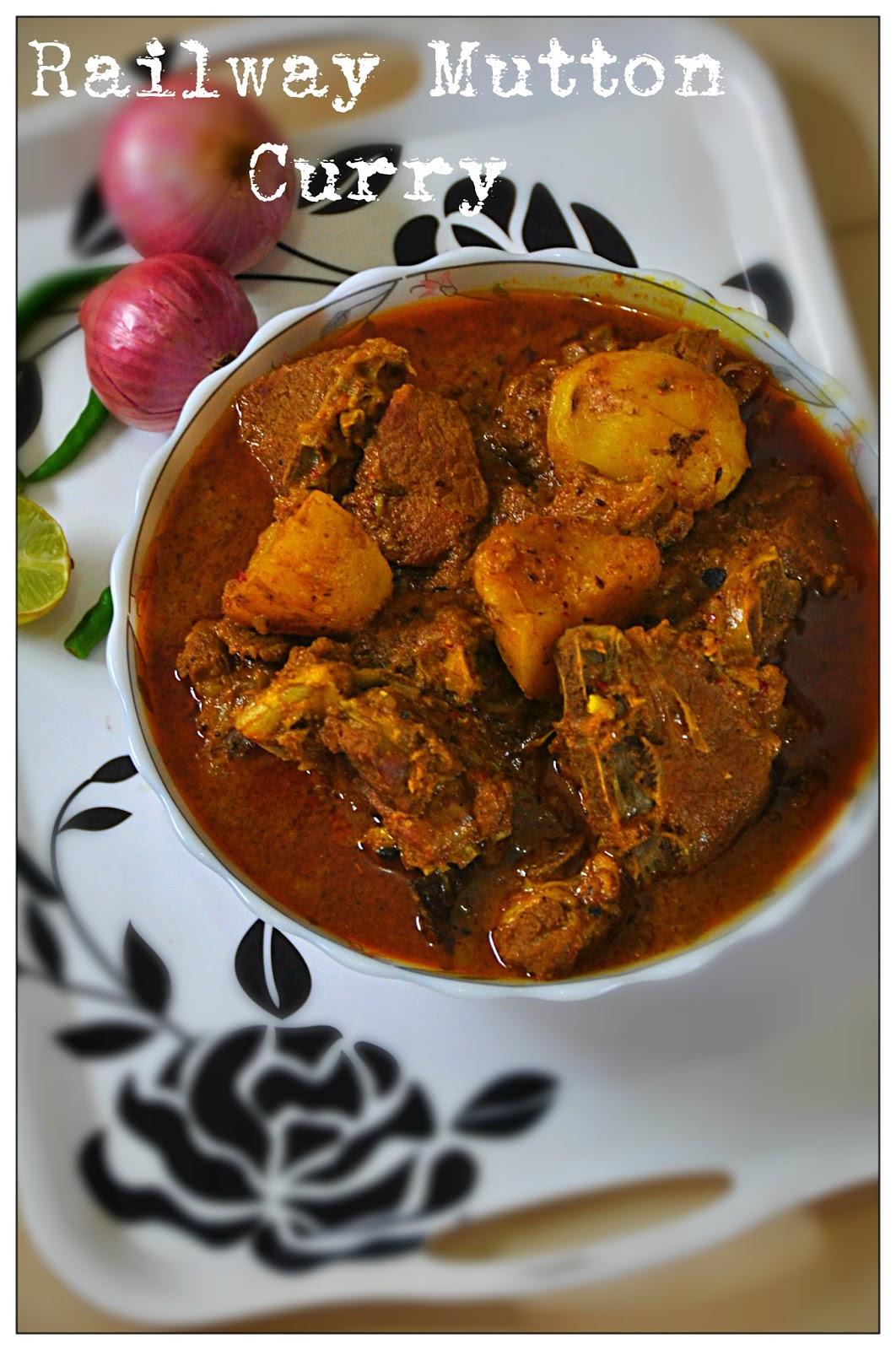
The Railways were a way of life during the days of the British Raj. Travelling First class was an experience in itself. The Burma teak cabins , plush interiors, classic railway cuisine, the servers in perfectly starched uniforms serving lunch to the sahibs – everything about a train journey was nothing short of collecting a bagful of memories, each unique from the other. Bengal,  the first stronghold of British rule, was heavily influenced by English cuisine. Many British families in India hired local cooks, and through them discovered local foods. The spiciness of foods had to be toned down or modified to suit the palates of the 'memsahibs'. Very distinct influence is seen in the desserts, some of which were created specifically to satisfy the British – most notably the very popular sweet LeÄ‘ikeni named after the first Vicereine Lady Canning. The other most popular remnants of that era is the Railway Mutton curry, which earned its name because it was served on the first class dining carriages.

As a kid I remember travelling to Darjelling in First class compartment with the entire gamut of relatives. My Mashi (aunt) used to stay in Darjelling with her family at that time as Mesho was posted there as a doctor. My Grandpa served as a doctor in the Railways for which he got First class passes. This first class was nothing like that of the British era but was definitely different and plush from the present day first class coaches. There were no aisle seats and there was a sliding door for each coup which ensured complete privacy. The first travel happened when I was some 5 year old and something really funny happened. We were some 10 odd people travelling together including  couple of kids so it goes without saying that there was never a dull moment. I remember we had got home cooked food in the big 3 tier tiffin carriers. At dinner time a newspaper would be spread out and everyone would be handed out steel plates on which the food which would consist of Daal, rice, a vegetable and a sweet would be served.  Post dinner we went to bed and were lulled to sleep by the swaying of the moving train.  The next morning I was woken up by mom. Reluctantly I followed her to the bathroom to brush. After cleaning me up she told me to walk down to our coupe which was quite near to the bathroom while she would finish brushing. Super confidently I started walking back, the third coup from bathroom was supposed to be ours. I entered the third and saw that everyone was asleep head to toe covered in quilt. Even my mom’s berth was occupied. When I left to brush I clearly remembered that granny and grandpa were already up, my other mashis (aunts) were up and preparing the beds and the kids were being woken up by their moms. How come within ten minutes everyone went back to sleep? Suspiciously I called out one of my Mashi’s name, the brush held firmly in my hands. No one answered. I was about to call once more when I felt someone tugging at my hands. I looked back to see the same Mashi whose name I was calling. She asked me what I was doing there in someone else’s coup. I realized the mix up and thanked my stars that no one woke up. Later on this story was reiterated a number of times to everyone adding all sorts of spice and tart. Poor me!

Train journeys had always been memorable for me, even the local train ones. The array of snacks that were sold during the journey was something I always looked forward to. Jhalmuri  with a slice of Coconut(puffed rice medley), veg-cutlet, mochar-chop (banana flower cutlet), chana chat (spicy chickpea) , ghughni,  tok jhal misti toffees (sweet & tart candies), chine badam beetnun diye (peanuts with black salt), seddho dim (boiled eggs), shal patae mora tatshaas (fruit of Palmyra Palm) etc. Not only the food but the chit-chat of the passengers, folk songs sung by the beggars, the passing paddy fields and different character of each station made up for a colorful experience. Before I digress more talking about train journeys coming back to the dish I am supposed to talk about.

Railway Mutton curry is a toned down version of the classic mutton curry (Manghor Jhol), with coconut milk diluting the spices and served with rice, bread or dinner rolls. Vinegar was added to the mix of mutton and potatoes to increase the durability of the meat during long journeys. The curry was not too spicy keeping in mind the delicate palates of the British. Though the dish originated in the colonial times it continued to be served in railway refreshment rooms and on long distance trains till much later.

When I searched the net I found quite a few variations of the recipe which is a clear indication of the train routes on which they were served. Coconut milk, tamarind and curry leaves were used in the recipe followed in Southern Railways. Whereas the northern and eastern railways adapted a recipe minus these. Sandeepa’s recipe (Bong Mom Cookbook) adapted from Pritha Sen’s recipe was the one I liked among all the others because of the presence of fennel seeds. Mutton and fennel seeds go hand in hand and I love the flavor a lot.

So here’s the recipe.
Preparation Time: 5 minutes 
Serves : 2

Ingredients :
For Marinade:
  • Mutton - 1 Kg
  • Ginger-Garlic Paste - 3 tsp
  • Mustard Oil - 1 tsp
  • Whisked Curd - 1/2 cup
  • Red Chilli Powder - 2 tsp
  • Turmeric Powder - 1/2 tsp
  • Salt
 For Paste:
  • Sauf/ Fennel Seed - 1 tsp
  • Coriander Powder - 1 tsp
  • Cumin Powder - 1 tsp
  • Black Peppercorn - 5-6
  • Dried Red Chilli  Whole- 7-8 
  • Garlic clove - 5
  • Ginger - 2" inch piece
  • Red chilli powder - 2 tsp
  • Sugar - As per taste
For Gravy
  • Onion - 2 large sliced finely
  • Tomato (pureed) - 1 big
  • Potato - 2 large, each halved
  • Curd - 1/2 cup whisked
  • Cardamom - 4
  • Cinnamon -  2" stick
  • Clove - 4 cloves
  • Nutmeg - 1/4 th tsp
  • Bay Leaf - 2
  • Ginger -Garlic Paste - 1 1/2 tsp
  • Warm Water - As required
  • Mustard Oil - 4 tbsp
  • Sugar & Salt - As per taste
Method:
1. Clean the mutton and marinate overnight with  the ingredients mentioned under marinade.

2. Heat a wok and add fennel seeds, peppercorn, dried red chillies. Stir for a few seconds then add the cumin and coriander powder. Roast till fragrant. 

3. Add the roasted spices mentioned above along with garlic clove, chopped ginger, red chilli powder and 1 tsp Mustard oil in the blender and blend into a fine paste. Keep aside.

4. Now fry the halved potatoes till edges turn a slight hint of brown. Keep aside.

5. Heat a wok and add 3 tbsp of mustard oil, when oil is steaming toss in the roughly ground whole garam masalas and bay leaf. Once the spices are fragrant add the ginger -garlic paste. Fry for a couple of minutes till raw smell is gone.

6. Now add the chopped onions and add a pinch of salt and sugar. Fry the onions till they start turning brown.

7. Add the pureed tomato and cook till it becomes a consistent mixture and raw smell is gone.

8. Lower the heat and add the whisked curd . Slowly stir it into the mixture. Cook for a couple of minutes.

9. Add the marinated mutton pieces into the mixture now and fold in.Cook on high flame for 3-4 minutes stirring continuously so that it does not stick to the wok. The pink colour of the mutton will turn a shade of light brown. Lower the heat and let the mutton slow cook.

10. Keep cooking the mutton and stirring occasionally till the mutton begins to release oil. It will require a patient cooking of nearly half and hour. If this process is done well the taste of the gravy will be good.

11. At this stage add the masala paste prepared separately and fold in with the mutton. Cook for 5 minutes.

12. Add the fried potatoes to the wok now.

13. Transfer all the contents of the wok into a pressure cooker and add required amount of warm water (water will be according to the water required for mutton to get properly cooked and get the desired amount of gravy). Close the lid and cook for 2 whistles on medium flame. (remember the number of whistles depend on the quality of mutton you have, sometimes it requires more than 2 whistles to cook the meat properly).

14. Once you turn off the heat after 2 whistles, let it sit for sometime till the pressure dies down. Open the lid and give everything a good stir. Add a spoon of ghee(clarified butter - optional) and 1/2 tsp of powdered garam masala. Close the lid and let the flavours seep into the meat properly for 30 minutes.

I served it with traditional Bengali pulao. You can also serve it with any kind of Indian bread (Roti/Naan etc).

Have a great year ahead and lots of mouthwatering foods!


Share
Tweet
Share
No comments
Newer Posts
Older Posts

About me

I am a software engineer by profession and a writer at heart. Born and brought up in Kharagpur, I moved to the city of dreams Mumbai when I got my first job. Till then I had not cooked a single dish in my life. Not even Maggi or tea. My dad had a strong belief that his little princess never will be in a situation where she had to cook for herself. Hence I was not allowed to spend time in the kitchen till I was studying.


So when I faced the daunting task of living alone, dabbas came to initial rescue. After that I managed a whole year on just boiled vegetables and rice. And then I landed in US. The bounty of fresh produce and cooking ingredients available in the super marts eventually lured me into making my very first meal ever. There was no turning back after that. I finally discovered how much I was in love with cooking and being creative in the kitchen.


This blog is a humble attempt to present our culinary heritage to one and all and document some of the very traditional recipes which gets passed on through generations just by word of mouth.


So just sit back with a cup of tea or coffee and enjoy the curries and the stories related to each.


Follow Us

Footprints

Blog Archive

  • ▼  2026 (4)
    • ▼  May (1)
      • A Suitcase Full of Stories: My Heartfelt Shopping ...
    • ►  January (3)
  • ►  2025 (3)
    • ►  December (1)
    • ►  June (1)
    • ►  February (1)
  • ►  2024 (21)
    • ►  December (2)
    • ►  September (1)
    • ►  August (3)
    • ►  July (4)
    • ►  May (2)
    • ►  April (5)
    • ►  March (3)
    • ►  January (1)
  • ►  2023 (7)
    • ►  December (2)
    • ►  November (1)
    • ►  October (1)
    • ►  May (1)
    • ►  March (1)
    • ►  January (1)
  • ►  2022 (18)
    • ►  September (1)
    • ►  August (2)
    • ►  July (2)
    • ►  June (3)
    • ►  April (1)
    • ►  March (3)
    • ►  February (2)
    • ►  January (4)
  • ►  2021 (60)
    • ►  December (5)
    • ►  October (5)
    • ►  September (5)
    • ►  August (7)
    • ►  July (6)
    • ►  June (5)
    • ►  May (3)
    • ►  April (4)
    • ►  March (6)
    • ►  February (6)
    • ►  January (8)
  • ►  2020 (55)
    • ►  December (5)
    • ►  November (3)
    • ►  October (10)
    • ►  September (7)
    • ►  August (7)
    • ►  July (9)
    • ►  June (3)
    • ►  May (9)
    • ►  March (1)
    • ►  January (1)
  • ►  2019 (3)
    • ►  November (1)
    • ►  April (1)
    • ►  January (1)
  • ►  2018 (1)
    • ►  December (1)
  • ►  2017 (4)
    • ►  December (2)
    • ►  November (1)
    • ►  September (1)
  • ►  2016 (10)
    • ►  August (1)
    • ►  July (2)
    • ►  June (5)
    • ►  April (1)
    • ►  March (1)
  • ►  2015 (10)
    • ►  December (1)
    • ►  August (1)
    • ►  June (1)
    • ►  May (2)
    • ►  April (4)
    • ►  March (1)
  • ►  2014 (22)
    • ►  November (2)
    • ►  August (2)
    • ►  July (3)
    • ►  June (2)
    • ►  May (4)
    • ►  April (3)
    • ►  January (6)
  • ►  2013 (22)
    • ►  November (2)
    • ►  October (4)
    • ►  September (5)
    • ►  August (2)
    • ►  July (1)
    • ►  June (1)
    • ►  May (2)
    • ►  April (1)
    • ►  March (1)
    • ►  February (2)
    • ►  January (1)
  • ►  2012 (31)
    • ►  December (4)
    • ►  October (3)
    • ►  September (8)
    • ►  July (1)
    • ►  June (1)
    • ►  May (14)
  • ►  2010 (9)
    • ►  July (3)
    • ►  June (2)
    • ►  April (1)
    • ►  March (2)
    • ►  February (1)
  • ►  2009 (4)
    • ►  February (2)
    • ►  January (2)

recent posts

Pinterest Board

Popular Posts

  • Champaran Mutton / Ahuna Mutton - A Bihari Delicacy
      When I finish a long week of work, self doubt, frustration of dealing with people and finally when the weekend comes, I feel cooking somet...
  • Kochur Dum / Kochur Dalna / Arbi Masala/ Taro or Colocasia Curry
    August 19 Kochu or taro is one of my favorite vegetables. It is as versatile as potato only much more tasty. It is equally starchy an...
  • Tetor Macher Jhol (Bitter Gourd Fish Curry)
    Anything Bitter hardly finds takers. Same applies for Bitter Gourd. As a kid I hated bitter gourd in any form. Grown ups around me would...
  • Khandeshi Kala Masala - Kala Mutton Masala
      25 September Maharashtra is a land of unique local flavours. And still it is mainly known for its Vada Pavs, poha, pav bhaji and modaks. I...
  • Macher Bhorta | Fish Bharta | Mach Makha| Bengali Style Mashed Fish
      October 18 Bhortas or bharta as we call it in pan India, are the quintessential Bengali food, a staple in Bangladeshi cuisine. They are th...
  • Complete Details to plan your ISKON Mayapur Visit
    Radha Madhav during Pushya Abhishek on 6th Jan 2023 First of all wish you a very happy new year. I have been away from blogging for a while ...
  • Varhadi Mutton - A Traditional Vidharba Cuisine
    Varhadi is a dialect of Marathi typically spoken in Vidarbha region of Maharashtra. Vidarbha is the north-eastern region of Maharashtra ...
  • Dim Toast | Egg Toast | Dim Pauruti | Savoury French Toast
      April 25 Calcutta or Kolkata. A city known for its food and culture, where hospitality and love are synonymous with lip-smacking grub. Cho...
  • Golda Chingri Malaikari (Giant River prawns in coconut milk gravy)
    One of the main reasons I love Kolkata is because of the fish we get here. Its so fresh and one can get restaurant grade fish quality even i...
  • Tangy Sweet Mint Fish | Fish Pudina Recipe | Fish Hariyali
    February 20 I am a hardcore fishiterian..if that's a word. There has been hardly any occurrence where I have tasted a fish and not liked...

Liebster Award

Liebster Award

Very Good Recipes

Very Good Recipes

You can find my recipes on Very Good Recipes

Contact Us

Name

Email *

Message *

Pages

  • Travelogue Index
  • VEGETARIAN RECIPE
  • CHICKEN RECIPES
  • SEAFOOD RECIPES
  • MUTTON RECIPES
  • RICE RECIPES
  • EGG RECIPES
  • DAAL RECIPES
  • ROTI & PARATHA RECIPES
  • BAKING RECIPES
  • SWEET RECIPES
  • SNACKS RECIPES
  • SIDES RECIPES
  • SOUP RECIPES
  • SALAD & BOWLS RECIPES
  • ROASTED RECIPIES
  • JAM & PRESERVE RECIPES
  • BEVERAGE RECIPES
  • SAUCES, SPICES & CURRY BASE RECIPES
  • CHUTNEY & DIPS RECIPES
  • FESTIVE RECIPES
  • Contact Us
  • TRAVELOGUES OF EAST INDIA
  • TRAVELOGUES OF WEST INDIA
  • TRAVELOGUES OF SOUTH INDIA
  • TRAVELOGUES OF NORTH INDIA
  • TRAVELOGUES of ASIA
  • North East Recipe

This Blog is protected by DMCA.com

DMCA.com for Blogger blogs
FOLLOW ME @INSTAGRAM

Curries n Stories © 2020 All rights reserved.
Created with by BeautyTemplates