• Home
  • Recipes
    • Vegetarian
    • Seafood
    • Snacks
    • Chicken
    • Mutton
    • Egg
    • Roti & Parathas
    • Dessert
    • Sides
    • Soups
    • Salad & Bowls
    • Rice
    • Daal
    • Bakes
    • Roasted
    • Beverages
    • Sauces, Spices & Curry Base
    • Chutney & Dips
    • Festive Recipes
  • Cuisine
    • Bengali
    • Maharashtrian
    • Rajasthan
    • Punjab
    • Chennai
    • Andhra
    • Mangalore
    • Mughlai
    • Kashmiri
    • Chinese
    • Singapore
    • Mexican
    • Continental
    • Italian
    • French
    • American
    • Thai
    • Bangladeshi
    • Arab & Persia
    • North East
  • Meal Type
    • Breakfast
    • Lunch
    • Dinner
    • Snacks
    • Dessert
    • Appetizer
    • Accompaniments
  • How To
    • Preservation Techniques
  • Travel
    • East India
    • West India
    • North India
    • South India
    • Asia
    • America
  • Lifestyle
    • Craft & Creation
    • Experiences
  • Musing
  • Contact
  • Bengali Blogs

Curries & Stories

pinterest facebook twitter instagram tumblr linkedin

Motor daal Lau data shaak


March 11

It is getting hot! Last year this day we were already under lockdown. It still makes me shiver at the thought of how overnight our world had changed. I remember on Holi last year which was on the 9th March, very few people had gone down to celebrate. We already heard the news of Covid spreading rapidly and some folks were already detected in Pune. I had skipped going down to play and just enjoyed from my balcony watching people play down. No one knew right form next day, it would be a different story.

A year has passed and not much has changed. In fact history is kind of repeating again. Maharashtra is again showing a spike and Holi is just round the corner.  Fingers crossed this time. Hopefully we will tide through with minimum impact.

Meanwhile due to the hot weather, now all my recipes are turning towards simple , easy to digest and soulful dishes. No heavy tadkas or oily food especially. The dish I am talking about today is a daal prepared with tender stems of bottle gourd. While adding bottle gourds to daal is a common practice, in Bengal we also like to add the stems and greens of Bottle gourd with the daal. The health benefits of bottle gourd is also present in its greens. It keeps your body cool and easy on the tummy. The taste and aroma is an added incentive. Bottle gourd pairs up fabulously with Motor daal. Yellow split pea lentil or motor is is a very common household daal in Bengal, but I have never seen it outside Bengal. It has a very typical aromatics which might not be pleasant to all, hence we usually pair it up with some vegetables to balance out the aroma. The daal that I used in here is sourced from Bengal. You can however check in your areas, at times there are some vendors who keep sourcing Bengali food items. During lockdown, many such vendors made there presence in Pune, which was one of the best things that could have happened in this phase. If you cant get your hands on motor daal, you can as well use masoor daal (red lentils) for this recipe. 

This daal goes best with steamed rice and some basic stir fried subzis, like potato fry or bitter gourd fry. But you can also enjoy it with any other vegetarian subzis.


motor daal with lau data


Check Out the DIY Background I made for this shoot.


Preparation Time: 10 minutes  
Soaking Time : 30 minutes - 1 hour
Cooking Time: 10 + 10 minutes
Serves : 2 to 3

Ingredients :
  • Yellow Split Pea Lentil or Motor Daal - 1 cup
  • Lau Data ( Tender stems of bottle gourd plant) - 2 inch pieces ( 1 cup)
  • Radhuni / Celery Seeds - 1/2 tsp
  • Dried Whole Red Chilli - 2
  • Bat Leaf - 1
  • Turmeric - 1/2 tsp or as required
  • Salt - as per taste
  • Mustard Oil - for tempering
For 2nd Tempering :
  • Dried Whole Red Chilli - 1
  • Ghee - 1 tsp
  • Red Chilli powder - 1/2 tsp

Procedure

1. Wash the daal and soak it in water for about half an hour.

Pro Tip: If you are in a hurry and don't have much time to soak daal before cooking, just soak the daal in hot water. It brings down the soaking time to half or less.

2. Meanwhile cut the tender bottle gourd stems into 2 inch pieces. 

Tip: Select the stems which are tender but fleshy, especially the nodes

3. Now in a pressure cooker, add the stems and some water to submerge the stems. Pressure cook for 1 whistle. Then immediately release the pressure by putting the cooker under running tap water. Separate the stems and preserve the water.

4. Now take the soaked daal in the cooker and add the preserved water from Step 3 and additional water to pressure cook the daal. Once the daal is cooked, give it a good stir with the spatula to break it down and make the consistency thick.

5. Add the boiled stems back into this daal.

6. Now in a pan add mustard oil. When the oil is hot, temper it with bay leaf, radhuni, dried red chillies till fragrant.

7. Add the boiled daal and stems into the pan. Add turmeric and salt and fold in. Cover and cook on medium till it gets a rolling boil.

8. For a second tempering, take some ghee in a pan. Once hot add one dried red chilli and 1/2 tsp of red chilli powder. Let it sizzle for about 40 seconds. Now pour it over the finished daal.

Serve it with rice and subzi of your choice.


Motor Daal Lau data shaak


Check Out the DIY Background I made for this shoot.


Share
Tweet
Share
No comments


Usually sona moong daal has an elite status in Bengal . It's a smaller variant of the regular moong daal and is more flavorful than its counterpart. It is not that commonly found in rest of India however. But one can elevate the beautiful aroma of moong daal just by following a simple trick - dry roast it. It serves two purposes- the daal becomes more aromatic and also it doesn't stick to each other.  Popularly we call it as Bhaja Moong er daal or fried moong daal. Its sort of a misnomer, because we really do not fry it but dry roast it. The earthy aroma of dry roasted daal on slow flame gives the daal its characteristic flavor. 

We cook moong in both ways - with or without roasting. The without roasting variant has easier recipes while the roasted one follows an elaborate recipe to create a scrumptious daal loaded with beautiful spices, roasted coconut chunks, vegetables or fish. While it tastes awesome that way, the process is long and laborious. So when you are looking for a quick weekday daal, it really doesn't fit the bill. And that is the reason why I used to not make moong daal very often until a few weeks ago.

My mom told me about a very simple moong daal recipe comprising of only Kalonji (Kalo jire) and chillies in the tempering. Initially a person like me who is either used to adding whole garam masala or white jeera would find it hard to visualize how the Kalonji will go with the flavor profile. But when I did give it a shot, it turned out so amazing that it has now become one of my go to daals. Its quick, easy and delicious. The fragrance of kalonji fried in ghee weds the earthy aroma of roasted moong and creates a lingering magic.

Preparation Time : 5 minutes
Cooking Time: 20 minutes
Serving : 3-4 people

Ingredients :
  • Moong Daal - 250 gm
  • Kalonji (Kalo Jire) - 1/2 th tsp
  • Bay Leaf - 1
  • Green Chilli - 3, slitted
  • Ghee - 2 tsp +1 tsp
  • Turmeric - 1/2 tsp
  • Salt to taste

Method:

1. Dry roast the Moong daal in a flat pan, preferably with wide surface area, so that you can move around the daal uniformly. Do this on a low to medium heat.

Tip: Keep stirring the daal to roast it uniformly. If you let it just sit there, some might burn while others might not even be roasted.

Note: Daal has to be washed after it is roasted.

2. As soon as you can see them turning a light shade of golden brown and get a nice aroma, transfer them to another vessel and wash it nicely with water.

3. Transfer the washed daal into the pressure cooker and add necessary amount of water (add more water if you want a soupy daal). You can keep this to soak for about 30 minutes and then pressure cook, so that it gets cooked sooner or you can directly put it on pressure cooking for approximately 2 whistles. Let the steam die off and then open the lid and give it a nice stir. If the daal breaks a bit it will taste better and the consistency will be thicker.

3. Now in a wok add 2 tsp of ghee. Once heated add the kalonji, bay leaf and the slitted green chillies.

Tip: Remember to slit the chillies before adding to the ghee, else it may splutter.

4. Add the boiled daal and fold in.

5. Add turmeric and salt and give it a stir. Let it simmer for about 5-7 minutes on medium flame with lid on. Once it comes to  a rolling boil, switch off the flame and top it off with 1 tsp of ghee. Put the lid back on and let it sit till you are ready to serve.

Tip: Vary the ghee amount as per your liking. 

Serve it with steamed rice and choice of vegetable subzi or fritters.

Do try this out and tag me (@curriesnstories07) on Instagram on your photos whenever you try the recipe and I will give a shout out to you.


Share
Tweet
Share
No comments


Day 40 of lock-down

This is the last day of lock-down 2.0. And we already know the lock-down is extended by another 15 days. We knew it even before it was official. Now a new extension date doesn't bring in new anxiousness because somewhere we are used to this. The new ways of working efficiently. and frankly somehow I like this. No more morning rush to beat the traffic for reaching office. No long travel in the evening. More time at home, practicing all good habits, getting ample rest and investing in creative activities which were always put on back burner before. Not to add, watching the nature healing and thriving in a human intervention less world.

It was a long weekend with the additional Labor day holiday and today being a Sunday before another work week starts, wanted to make something simple and soothing. Bitter has become a part and parcel of my menu during lock-down. Different forms of bitter, be it in the form of subzi, or in daals or even in fish curries. They all taste great, work as a palate cleanser and is healthy too.

Our society is arranging vegetable vendors to visit us twice a week and and fruit vendors once a week. This arrangement was done to discourage people from venturing out unnecessarily in search of vegetables. Also, it was beneficial to the nearby farmers as well. They could sell all their produce in a hassle free manner. I had got some karela this week. Usually I was preparing karela ki subzis or stir fries on all the preceding weeks, so this time wanted to change that ritual and make a daal.

Tetor Dal is traditional Bengali daal which is often cooked during summer time in bengali homes. Teto means bitter in Bengali. Since bitter gourd is cooked with the daal hence the name. Traditionally ucche is used instead of Karela. But in my place I don't get ucche so I use Karela instead. There is hardly any difference of taste though. But inspite of the name, the daal doesn't taste bitter. In this, the bitter gourd is fried to a crisp before adding to the daal. This which adds a nice flavor and a mild bitterness to the daal. Thus even people who hate anything bitter in their meal, will enjoy this without any complains.

My mom usually makes this daal with matar daal. Matar daal itself has a very earthy fragrance. So it along with bitter gourd gives off a very unique flavor. Again, I don't get matar daal in my area so I had to look for the next best substitute. Today it is moong daal with karela, tempered with jeera, fresh ginger, dry red chillies and radhuni. Finally topped it off with ghee for that added flavor boost.


Preparation Time : 15 minutes
Cooking Time: 20 minutes

Ingredients:
  • Moong Daal - 100 gm
  • Karela (Bitter Gourd) - 1
  • Jeera (Cumin) - 1/2th tsp
  • Radhuni (optional) - 1/4 th tsp
  • Dry Red Chilli - 2
  • Green Chilli - 2
  • Ginger - 1 tsp
  • Refined Oil
  • Ghee - 2 tsp
  • Turmeric
  • Salt as per taste

Procedure: 

1.  Wash the daal and let it soak for half an hour

2. Cut the Karela in roundels and take any hard seeds off

3. Fry the karela until crispy. Keep it aside


4. Boil the daal till soft

5. Grate the ginger and separate the husk from the ginger juice. Keep both of them.

6. Now take a wok and add some refined oil and the ghee. Once its hot temper it with dried red chilli, ginger husk, jeera and radhuni. Saute till fragrant.


Note: Radhuni is optional. If you don't have radhuni, only jeera is sufficient

7. Add the boiled daal to this and add the turmeric, green chilli and salt. Also add the ginger juice now.  Let it come to a rolling boil. 

8. Now add the fried Karelas and let it cook for another 2-3 minute

9. Top if off with a dash of ghee


Enjoy the daal with steamed rice and choice of vegetable side.

Do try this out and tag me (@curriesnstories07) on Instagram on your photos whenever you try the recipe and I will give a shout out to you.

Share
Tweet
Share
No comments

Hello Readers, I am back like more than a year after. Different commitments on personal and professional fronts kept me away from my blog which I missed so much. And what can be a better time to be back other than our very dear Durga Pujas.

Just as Mahalaya was approaching the smell in the air also started changing. Especially in the mornings, one could distinctly smell the Shiuli, the signature smell of Durga Puja mornings. The place where I stay has a few Shiuli Trees on the way and passing them brings back a lot of childhood memories. During the Durga Pujas as a kid I visited my maternal grandparents house. We had a Shiuli tree in the garden. My dida used to wake very early in the morning and gather the flowers fallen on the ground for doing prayers. That earthy smell of morning mist and Shiuli is something I can only talk about but one has to experience it to understand.

This time around Durga Puja is happening on all weekdays. Hence I decided to take two days off on Ashtami and Navami. Pushpanjali, Pandal Hopping and Pet Puja was the main agenda for the days. Yesterday I went for the Ashtami Pushpanjali at Apte Road. Its a Puja hosted by the Bengali Association. The Puja used to happen in Siddhi Garden on Raja Mantri Road till last year which was considerably closer to my place. But for some reason this time they shifted base to the Central Park Hotel grounds which is pretty far from my place. By chance I noticed the change in venue, when it came in paper but many were not so lucky and ended up clueless after reaching Siddhi Gardens. Hence I felt the attendance was quite less as well at the pandal. Plus the previous location seemed better in terms of ambiance and space. I felt overall look was also lackluster unlike last year. Post pushpanjali I had luchi and cholar daal at the stall and it was super! Breaking the fast with such a scrumptious dish makes your day really.
Top: Congress Bhavan , Bottom : Apte Road
The other Puja I went to was of Congress Bhavan. Its also a very old Puja in Pune. And the pratima of Ma Durga over there was really very beautiful. She was decked in my favourite colours red and gold.  Stayed there for a while and then got some misti doi and fish fry as parcel and came back home.
Fish Fry & Misti Doi
Fortunately I was home before a heavy downpour started in the afternoon. This has been a lingering problem this puja. The rains are playing a spoilt sport this time every single day. Infact we had a dust storm today followed by a heavy downpour in the afternoon. I had plans of visiting otehr pandals in the city today but considering the weather I changed my mind and impromptu decided to make a full blown Bhog on Navami. Fortunately for me the main ingredients were all avilable in the pantry, a few of the vegetables I had to get from the market. It took me whole morning to prepare and make each of them but it was super fun and the final product was so awesome that I wish I could pat myself on the back.

Bhoger Khichudi is very special to every Bengali. It not only has the flavours of spices but the aroma of dhuno, which makes it taste awesome. Now when you prepare at home the aroma of dhuno apart everything else can be mimicked. I had made many mooger daaler khichudi before but this particular recipe that I found on the net today really came out awesome! I just added a little things here and there differently from the recipe. See the original recipe here.


Niramish Moong Daal Khichudi

Preparation Time: 30 minutes  
Cooking Time:  1 hour 45 minutes
Serves: 4
Cuisine: Bengali

Ingredients:
  • Sona Moong Daal/ Unpolished Moong Daal - 1 cup
  • Gobindobhog Rice / Kolam Rice - 1 cup
  • Fresh Ginger paste- 2 1/2 tbsp
  • Green Chillies - 3
  • Potato - 2 medium , diced
  • Cauliflower - 1 small, Cut into medium sized florets
  • Fresh Coconut - half cup cut into small pieces
  • Green Peas - 3/4 cup or as per preference
  • Raisins - handful, soaked for 5 minutes in water
  • Cumin Powder  - 1 tbsp
  • Turmeric Powder - 2 tbsp
  • Everest Sahi Garam Masala Powder - 1 tsp
  • Ghee (clarified butter) - 2 tbsp
  • Mustard Oil for frying
  • Sugar as per taste
  • Salt - as per taste
Procedure
1. Wash the rice and keep aside

2. Heat a heavy bottomed kadhai and add the daal to it. Dry roast it  till some of the daal gets a light bown/pink color, while stirring continuously with a spatula. You need to continuously stir it because unattended daal might burn which will impact the taste. Wash the roasted daal in cold water. Transfer the washed daal into the same kadhai and add 4 cups of water. On medium head cover and cook the daal till its half cooked.


3. Once the daal is half cooked add the washed rice and cook them together till rice is half 3/4th cooked. Add more water if required.

4. I used frozen peas here. So thaw the peas for half an hour by putting them in water. If using fresh peas, just peel and keep them aside.

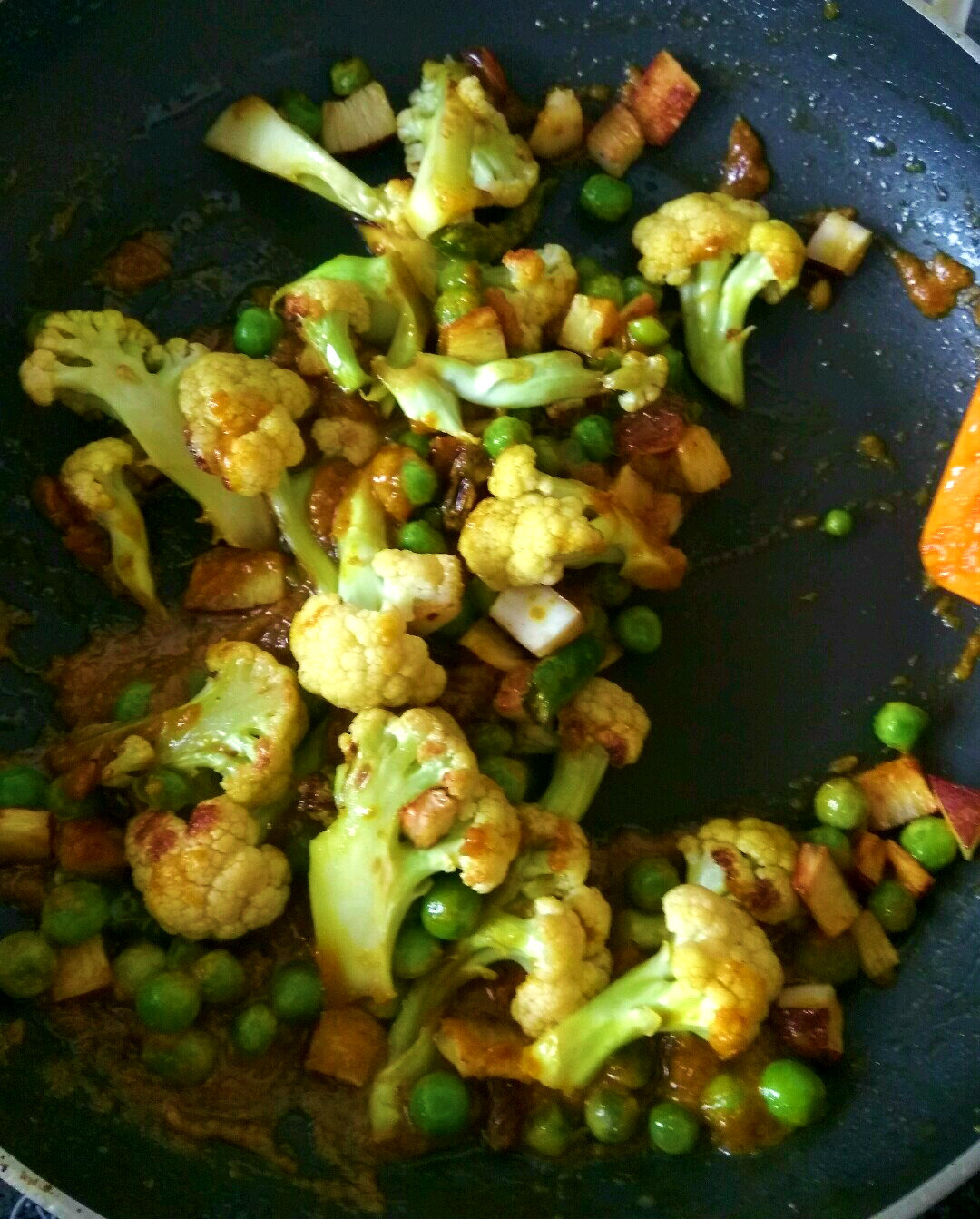
5. Take another wok and fry the cauliflower florets, peas and diced potato. Keep aside

6. Add some ghee in the wok and fry the coconut pieces till edges are lightly brown. Then in leftover ghee toss the raisins for 1 minute. Keep this aside as well.


7. Now add 2 tbsp of mustard oil and let it heat. Toss in split green chillies and add the ginger paste, turmeric, cumin powder, salt and sugar. Saute for a few minutes lowering the flame so that raw smell of ginger is gone. Add a little water to make it a paste. Add the fried cauliflower, potato, peas, raisin and coconut and fold in.


8. Add this masala to the almost cooked rice and daal. Fold in. If you feel more turmeric is required add now. I also added 1 tsp of raw ginger paste at this stage to enhance the flavour. Let it cook for a while till everything is cooked nicely. Make sure you stir occasionally so that the khichudi doesn't stick to the base of the wok. 


9. When the khichudi is almost done, add the garam masala and top it off with a generous amount of ghee. Fold everything in and let it rest. Put the lid on so that the flavours are properly infused.

Enjoy your khichudi hot!


Labrar Torkari (Vegetable Medley)

Preparation Time: 20 minutes  
Cooking Time: 50 minutes
Serves: 4
Cuisine: Bengali

Ingredients:
  • Potato - 2 medium, each cut into four pieces
  • Sweet Potato - 4, diced
  • Pumpkin - 100 gm, diced
  • Brinjal - 2 medium, diced
  • Borboti (yard long beans) - 12, cut into 1 inch pieces
  • Fresh Ginger paste - 1 tsp
  • Fennel seeds - 1/2 tsp
  • Kalonji - 1/4 tsp
  • Fenugreek seeds or Methi dana - 1/4 tsp
  • Mustard Seeds - 1/4 tsp
  • Dried Red Chilli - 1
  • Turmeric - 1 tsp
  • Mustard Oil - 1 tsp
  • Sugar as per taste
  • Salt - a pinch

Procedure
1. Cut the vegetables as mentioned and keep them in water for 15-20 minutes.

2. Heat a heavy bottomed kadhai and add mustard oil. Fry all the vegetables in the following order - Potato, sweet potato, pumpkin, brinjal. Add a little salt while frying, to get them cooked quickly. And keep them aside. Then fry the borboti separately so that you can control the color. Keep aside.

Note: Frying the vegetables separately will give the dish a better taste

3. Heat a heavy bottomed kadhai and add mustard oil. When it is smoking add all the whole spices and red chilli. When the spices are fragrant add the ginger paste and fry for 30 seconds. Add the fried vegetables to it. Add turmeric, salt and sugar and fold everything in. Fry for a while till the raw smell of ginger is gone. 

4. Now add 1 and 1/2 cup cups of water and cover the pan. Let the vegetables get cooked properly. Give it an occasional stir so that the vegetables doesnt stick to the pan.

5. When the vegetables are tender, open the lid and dry any excess water till the vegetables reach its desired consistency.


Gobindobhog Chaler Payesh (Rice Kheer)

Preparation Time: 5 minutes  
Cooking Time: 15 minutes
Serves: 2
Cuisine: Bengali

Ingredients:
  • Gobindo bhog chal - 5 tsp
  • Full cream milk - 400 gm
  • Bay Leaf - 1
  • Raisins - handful
  • Nolen gur (optional) 2 tbsp
  • Sugar - 2 1/2 tsp

Procedure
1. Wash and keep the rice soaked in water for 30 minutes

2. Heat a heavy bottomed kadhai and add the full cream milk. Add the bay leaf. Let it come to a boil and then add the soaked rice. Reduce the flame to medium. Keep stirring it continuously so that layer doesnt form on the milk.

3. When the milk is reduced to half add the sugar. Keep coking it till the rice is cooked completely.

4. Meanwhile grate the gur and make a paste of it with water and keep aside.

5. When the payesh is almost done, switch off the flame and add the gur to it. Fold in. Make sure you add the gur only after heat is switched off else the milk might curdle.

Let it rest for a while. Serve the payesh hot or cold with the bhog.


Tomato Chutney

Click here to see the recipe ->


Serve everything piping hot. Add a dash of ghee to the khichudi before serving and have fried papads on the side.

Wish you all a happy Durga Puja!


Share
Tweet
Share
1 comments

I am a person who cannot live without her daily dose of fish. For me fish is not an option but a necessity. As a person who was used to having fish during lunch and dinner during childhood, I barely manage through the office canteen food only to look forward towards the dinner when I would whip up a delicious fish curry to go with rice or roti.

I can have any fish in any form ( barring the dried ones, the smell just puts me off) - fried, curried, steamed, medley and the list goes on. I remember during our Engineering days when kids used to go back home during the vacations they would usually ask their moms to make all sort of chicken delicacies throughout the vacation. I would always give my mother a list of fish preparations that I would crave throughout my stay in the hostel. Not that the hostel didn't serve fish, it surely did and the fishes would be fresh too. But it would lack the variety and amount. We only got to have Rohu at the hostel and only one piece per person. I was crazy about Magur/Shingi (catfish) at that time and that is such a fish which is only cooked in individual homes as it does not have universal appeal. I would request my parents to get me Magur or Shingi almost every day of my stay at home. My father would insist on getting chicken but I would ask him to get lots of different fish instead. My mom is an amazing cook and she also has this experimental streak in her which proved most beneficial for me. She would look such varied fish dishes for me that I would feel at food heaven - Macher Paturi (fish wrapped and steamed in pumpkin leaves), fish croquette, fish crispy fry, macher ghonto (fish in vegetable medley), the quintessential Bengali fish curry, macher kalia (fish in rich onion sauce) and macher matha die daal (lentil cooked with fish head). There were some other recipes also which I am unable to recollect right now. Apart from Magur I also liked Katla, Koi, Hilsa, prawn and Tilapia. Among these Hilsa would be made rarely as it would cause an upset stomach if not eaten in moderation due to its rich oil content.


I still have vivid memories of every memorable fish encounter I had till date. Like the time we went to my aunt's home in Taki, a small town in Hashnabad near Kolkata. Its a border area of India and Bangladesh. The fish you would get over there was just amazing. I still remember having these huge juicy Jumbo prawns at her home, they would not fit in any serving bowl. Guys believe me I have never seen such huge prawns ever again in my life. Or the Koi macher Paturi that my grandma used to make when we visited her home during childhood. There was a time when Hilsa was fried in any home the entire neighbourhood would come to know about it due to the signature mesmerizing aroma of the fried fish. Gone are those days when you got such quality fishes. Original fishes are now exported to foreign countries and we are left with the option of Hybrid ones. Now even if you fry Hilsa in the kitchen the person in the other room wont know about it. The only hybrid fish that tastes better than the original ones are the catfish. And we get them in abundance in Pune. Magur are 'geol' fish or fishes with two respiratory organs hence they can live for longer time without water. That's why you would see me using catfish in most of my fish curries.

The love and craziness for fish continues till date. Even today when I visit home me and mom go to the market and purchase a cartload of fish to sustain us for the entire vacation. I hear my mom and granny say at times that the quality of fish has gone down over the years and you don't get good fish now but I still find the fishes from the local market in Kolkata amazingly tasty and delectable as compared to what we get in Pune. Though I love sweet water fish better than the salt water ones but on account of my job I am out of Bengal for more than a decade hence I try to get used to the salt water ones as well.
I choose my travel destinations where is is chance of having fish. Like for an example Kerala. And seriously it was an amazing experience eating fried fish paired with fine red wine in a rustic cottage 10 feet away from the sea, by the moonlight listening to the huge waves crash on the shore. Just us and the sea - simple and heavenly. The very mundane Goan fish curry we had at a small joint in the market of Munnar or the crispy fried fish from our very own Panshet Dam in Pune - each with a signature touch and comforting feel. Till date locations which would offer us seafood cuisine wins hands down over those which does not. The entire Konkan belt of Maharashtra offers a wide assortment of seafood. While in Goa last year we had one of the finest King crab preparations at Full Moon shack (Bogmallo Beach) at dirt cheap rate. Next in the list is having Trout fish in the emerald valleys of the Great Himalayas.

I can write an epic regarding my love for fish. But coming back to the main topic of discussion today - Macher maths diye Muger Daal.Daal quintessentially fits into the very staple diet of any Indian and 99% of the time its vegetarian preparation. But Bengalis are known for their love of non-vegetarian and fish of course. So its not very surprising to note that a Daal preparation with fish head would find its way into the elite list of Bengali delicacies. In fact the only other non-veg daal that I know of is Daal Ghost (Lamb in lentil soup) of the Mughlai Origin. Maybe there are other non-veg daals also present in the country but I am totally ignorant about those. Maybe any of you reader can tell me all about it.

Yellow daal or Mung daal is a very favorite daal in Bengal. Its reserved for all special occasions. Else where in the country you would get the normal Mung daal but in Bengal you would get a special variety of Mung daal known as the "Shona Muger Daal" which is a smaller grained more aromatic version of the normal one. You have to experience Shona Muger daal to know about its awesome taste. Macher matha diye muger daal is a very traditional dish only reserved for special occasions like wedding or birthday meals. Its an elaborate preparation which takes time and patience. The common way of preparing this dish is dry roasting the Muger daal lightly to make Bhaja Muger Daal. Dry roasting the daal gives off beautiful earthy flavors and imparts the dish body and richness. But I prefer to use Kacha muger daal or the non roasted version. The roasted version definately tastes better but is also difficult to digest. So if you want to relish your favorite non veg daal without the fear of an upset stomach use the un-roasted version.

Apart from Asian people I doubt whether anyone would know what its to have a fish head. Most of you would say it sounds so gross. A colleague of mine one said how can you eat a fish head with the eye staring back at you? Ah! the joys of a fish head can only be experienced and not explained. As kids we were always told to have fish heads as they would make us intelligent. We never tried to find out the truth behind the statement but since we loved fish head anyway logic or no logic we relished them wholeheartedly.

On Friday while coming home I saw this nice and big Katla fish with an equally huge head. Couldn't resist buying it and hence the menu for the weekend was going to feature the non veg daal recipe for sure. I replicated my mom's tried and tested recipe with a slight modification. I added a couple of veggies to the daal as well. Actually this particular preparation has two variants the veg one and the non veg one. Just minus the fish head and replace it with a lot of veggies to make the veg version. Mine was a medley of both worlds and it came out super delicious.

Don't get intimidated  by the long list of ingredients, have patience and follow the steps carefully and you would have that super rich and creamy daal at your fingertips.

Preparation Time: 20 minutes  

Cooking Time: 30 minutes

Serves: 4


Cuisine: Bengali 
Ingredients:
  • Mung Daal (Yellow Lentil) -300 gm
  • Big Fish Head - 1
  • Onion - 2 big 
  • Tomato - 1 big
 For Tempering
  • 5 Spice Mix (Panch Foron) - 1 tsp
  • Clove (Laung)- 3
  • Cinnamon (Dalchini) - 2 inch piece
  • Green Cardamom (Elaichi) - 3
  • Dried Red Chilli - 2
  • Bay Leaf - 2
  • Ginger - 3 inch made into paste
  • Garlic - 4 cloves made into paste
Other Spices & Vegetables
  • Garam Masala Powdr - 1 tsp 
  • Turmeric Powder as required
  • Red Chilli Powder - 1/2 tsp
  • Jeera Powder (Cumin Powder) - 1tsp
  • Coriander Powder (Dhania Powder ) - 1tsp
  • Green Peas (Frozen or fresh) - 1/4th cup 
  • Carrot - 1 medium diced
  • Green chilli - 2 slitted
  • Salt & Sugar as per taste
  • Ghee - for seasoning
  • Mustard Oil for tempering
 
Procedure:

1.Thaw the frozen peas or blanch the raw ones. Once soft drain the water keep them aside.

2. Make julienne of the onion.  Chop the tomatoes. Dice the Carrot into big chunks.

3. Make a paste of fresh ginger and garlic.
 
4. Marinate the fish head with salt and turmeric for about 30 minutes. Heat oil in a wok and fry the fish heads taking care not to break them. For very big fish heads make sure you fry them enough on all sides so that the raw smell of the fish disappears. No need to drain the oil from the fried heads.


5. Dry roast the daal for about 4-5 minutes on medium flame, stirring continuously till the corners of daal is little browned and you get a nice aroma of the fried daal. note the daal might get burnt quickly if you are not stirring it continuously.

6. Wash the roasted daal. If possible soak the daal for 10 minutes in water prior to cooking. It will help in cooking the daal faster. If you are adding Carrots add it with the daal to get pressure cooked.

7. Take a pressure cooker and add enough water to cook the daal. Pressure cook for two whistles or as required.  Once the pressure dies out, whisk the daal with a spatula to break some of the daal and that should give a thick consistency.


Take out the boiled carrots from the daal before whisking it. We don't want the carrots to get all mashed up. Add the carrots back  into the final whisked daal.


8.  Coarsely grind the clove, cardamom and cinnamon with a mortar pestle to release their flavours

9. Heat the remaining oil in the wok. Add a spoonful of ghee. When steaming add the bay leaf, ground clove, cinnamon, cardamom, 5 spice mix, dried red chilli torn in-between.

10. When you get the aroma of the spices add the ginger garlic paste, onion julienne and diced tomato. Fry until mushy. Add a bit of water frequently to prevent the masala from sticking to the bottom of the wok. Note: I also added some pointed gourd pieces also at this point to get fried along with the masalas. You can also toss in some raisins if you like at this point.

11.  When oil separates from the fried masalas add turmeric powder, cumin powder, coriander powder, salt and sugar. Fold in.

12. Add the soft peas at this point. Mix well.

13. Add the fried fish heads at this point. Coat it with the masalas in the wok. Keep tossing so that it doesn't get burnt. The fish head will automatically start break by the sides. If not slightly break them up to infuse the juices better into the daal.

14. Add the boiled daal with the carrots at this point. Mix everything well taking care not to break the fish heads too much.

If you want to prevent the fish head from breaking too much. Then you can take out the heads from the masalas before the daal is added. Add the daal let it boil and mix with the masalas completely and finally add the head back and boil for a couple of minutes.


15. Break in a few slitted green chillies for that added spiciness. Add enough water to make the daal medium soupy. This is going to be a thick daal and not a runny one.

16, Let the daal simmer for about 7-10 minutes with occasional stirring.

17. Add a dash of garam masala powder and 1 tsp of ghee. Mix well and turn off the heat.

Serve it with steamed rice or basmati rice along with an assortment of vegetable fritters. I served it with niramish Potoler Dolma (Stuffed Pointed gourd).


Share
Tweet
Share
No comments
Older Posts

About me

I am a software engineer by profession and a writer at heart. Born and brought up in Kharagpur, I moved to the city of dreams Mumbai when I got my first job. Till then I had not cooked a single dish in my life. Not even Maggi or tea. My dad had a strong belief that his little princess never will be in a situation where she had to cook for herself. Hence I was not allowed to spend time in the kitchen till I was studying.


So when I faced the daunting task of living alone, dabbas came to initial rescue. After that I managed a whole year on just boiled vegetables and rice. And then I landed in US. The bounty of fresh produce and cooking ingredients available in the super marts eventually lured me into making my very first meal ever. There was no turning back after that. I finally discovered how much I was in love with cooking and being creative in the kitchen.


This blog is a humble attempt to present our culinary heritage to one and all and document some of the very traditional recipes which gets passed on through generations just by word of mouth.


So just sit back with a cup of tea or coffee and enjoy the curries and the stories related to each.


Follow Us

Footprints

Blog Archive

  • ▼  2026 (4)
    • ▼  May (1)
      • A Suitcase Full of Stories: My Heartfelt Shopping ...
    • ►  January (3)
  • ►  2025 (3)
    • ►  December (1)
    • ►  June (1)
    • ►  February (1)
  • ►  2024 (21)
    • ►  December (2)
    • ►  September (1)
    • ►  August (3)
    • ►  July (4)
    • ►  May (2)
    • ►  April (5)
    • ►  March (3)
    • ►  January (1)
  • ►  2023 (7)
    • ►  December (2)
    • ►  November (1)
    • ►  October (1)
    • ►  May (1)
    • ►  March (1)
    • ►  January (1)
  • ►  2022 (18)
    • ►  September (1)
    • ►  August (2)
    • ►  July (2)
    • ►  June (3)
    • ►  April (1)
    • ►  March (3)
    • ►  February (2)
    • ►  January (4)
  • ►  2021 (60)
    • ►  December (5)
    • ►  October (5)
    • ►  September (5)
    • ►  August (7)
    • ►  July (6)
    • ►  June (5)
    • ►  May (3)
    • ►  April (4)
    • ►  March (6)
    • ►  February (6)
    • ►  January (8)
  • ►  2020 (55)
    • ►  December (5)
    • ►  November (3)
    • ►  October (10)
    • ►  September (7)
    • ►  August (7)
    • ►  July (9)
    • ►  June (3)
    • ►  May (9)
    • ►  March (1)
    • ►  January (1)
  • ►  2019 (3)
    • ►  November (1)
    • ►  April (1)
    • ►  January (1)
  • ►  2018 (1)
    • ►  December (1)
  • ►  2017 (4)
    • ►  December (2)
    • ►  November (1)
    • ►  September (1)
  • ►  2016 (10)
    • ►  August (1)
    • ►  July (2)
    • ►  June (5)
    • ►  April (1)
    • ►  March (1)
  • ►  2015 (10)
    • ►  December (1)
    • ►  August (1)
    • ►  June (1)
    • ►  May (2)
    • ►  April (4)
    • ►  March (1)
  • ►  2014 (22)
    • ►  November (2)
    • ►  August (2)
    • ►  July (3)
    • ►  June (2)
    • ►  May (4)
    • ►  April (3)
    • ►  January (6)
  • ►  2013 (22)
    • ►  November (2)
    • ►  October (4)
    • ►  September (5)
    • ►  August (2)
    • ►  July (1)
    • ►  June (1)
    • ►  May (2)
    • ►  April (1)
    • ►  March (1)
    • ►  February (2)
    • ►  January (1)
  • ►  2012 (31)
    • ►  December (4)
    • ►  October (3)
    • ►  September (8)
    • ►  July (1)
    • ►  June (1)
    • ►  May (14)
  • ►  2010 (9)
    • ►  July (3)
    • ►  June (2)
    • ►  April (1)
    • ►  March (2)
    • ►  February (1)
  • ►  2009 (4)
    • ►  February (2)
    • ►  January (2)

recent posts

Pinterest Board

Popular Posts

  • Champaran Mutton / Ahuna Mutton - A Bihari Delicacy
      When I finish a long week of work, self doubt, frustration of dealing with people and finally when the weekend comes, I feel cooking somet...
  • Kochur Dum / Kochur Dalna / Arbi Masala/ Taro or Colocasia Curry
    August 19 Kochu or taro is one of my favorite vegetables. It is as versatile as potato only much more tasty. It is equally starchy an...
  • Tetor Macher Jhol (Bitter Gourd Fish Curry)
    Anything Bitter hardly finds takers. Same applies for Bitter Gourd. As a kid I hated bitter gourd in any form. Grown ups around me would...
  • Khandeshi Kala Masala - Kala Mutton Masala
      25 September Maharashtra is a land of unique local flavours. And still it is mainly known for its Vada Pavs, poha, pav bhaji and modaks. I...
  • Macher Bhorta | Fish Bharta | Mach Makha| Bengali Style Mashed Fish
      October 18 Bhortas or bharta as we call it in pan India, are the quintessential Bengali food, a staple in Bangladeshi cuisine. They are th...
  • Complete Details to plan your ISKON Mayapur Visit
    Radha Madhav during Pushya Abhishek on 6th Jan 2023 First of all wish you a very happy new year. I have been away from blogging for a while ...
  • Varhadi Mutton - A Traditional Vidharba Cuisine
    Varhadi is a dialect of Marathi typically spoken in Vidarbha region of Maharashtra. Vidarbha is the north-eastern region of Maharashtra ...
  • Dim Toast | Egg Toast | Dim Pauruti | Savoury French Toast
      April 25 Calcutta or Kolkata. A city known for its food and culture, where hospitality and love are synonymous with lip-smacking grub. Cho...
  • Golda Chingri Malaikari (Giant River prawns in coconut milk gravy)
    One of the main reasons I love Kolkata is because of the fish we get here. Its so fresh and one can get restaurant grade fish quality even i...
  • Pahadi Bhatt Ki Daal | Black Soyabean Dal
      Happy 76th Independence Day to all my readers! Today we are celebrating 75 years of independence and that is such a remarkable thing. the ...

Liebster Award

Liebster Award

Very Good Recipes

Very Good Recipes

You can find my recipes on Very Good Recipes

Contact Us

Name

Email *

Message *

Pages

  • Travelogue Index
  • VEGETARIAN RECIPE
  • CHICKEN RECIPES
  • SEAFOOD RECIPES
  • MUTTON RECIPES
  • RICE RECIPES
  • EGG RECIPES
  • DAAL RECIPES
  • ROTI & PARATHA RECIPES
  • BAKING RECIPES
  • SWEET RECIPES
  • SNACKS RECIPES
  • SIDES RECIPES
  • SOUP RECIPES
  • SALAD & BOWLS RECIPES
  • ROASTED RECIPIES
  • JAM & PRESERVE RECIPES
  • BEVERAGE RECIPES
  • SAUCES, SPICES & CURRY BASE RECIPES
  • CHUTNEY & DIPS RECIPES
  • FESTIVE RECIPES
  • Contact Us
  • TRAVELOGUES OF EAST INDIA
  • TRAVELOGUES OF WEST INDIA
  • TRAVELOGUES OF SOUTH INDIA
  • TRAVELOGUES OF NORTH INDIA
  • TRAVELOGUES of ASIA
  • North East Recipe

This Blog is protected by DMCA.com

DMCA.com for Blogger blogs
FOLLOW ME @INSTAGRAM

Curries n Stories © 2020 All rights reserved.
Created with by BeautyTemplates