
• Home
  • Recipes
    • Vegetarian
    • Seafood
    • Snacks
    • Chicken
    • Mutton
    • Egg
    • Roti & Parathas
    • Dessert
    • Sides
    • Soups
    • Salad & Bowls
    • Rice
    • Daal
    • Bakes
    • Roasted
    • Beverages
    • Sauces, Spices & Curry Base
    • Chutney & Dips
    • Festive Recipes
  • Cuisine
    • Bengali
    • Maharashtrian
    • Rajasthan
    • Punjab
    • Chennai
    • Andhra
    • Mangalore
    • Mughlai
    • Kashmiri
    • Chinese
    • Singapore
    • Mexican
    • Continental
    • Italian
    • French
    • American
    • Thai
    • Bangladeshi
    • Arab & Persia
    • North East
  • Meal Type
    • Breakfast
    • Lunch
    • Dinner
    • Snacks
    • Dessert
    • Appetizer
    • Accompaniments
  • How To
    • Preservation Techniques
  • Travel
    • East India
    • West India
    • North India
    • South India
    • Asia
    • America
  • Lifestyle
    • Craft & Creation
    • Experiences
  • Musing
  • Contact
  • Bengali Blogs

Curries & Stories

pinterest facebook twitter instagram tumblr linkedin

Day 60 of Lockdown

First of all Eid Mubarak to any of my readers who is celebrating it today. The year has been pretty weird for all of us, and we are spending most of the celebrations locked up in our homes. But this is also an experience. What cant we achieve even when our resources are limited? Its just a mindset change that's it. 

This being a long weekend, I thought why not try something more elaborate this time. I had some chicken languishing in the freezer for quite sometime now. Thought to put that to good use. I am not a big biryani lover or rather I am a biryani lover but I am very specific about what biryani I like. Most of the times biryanis have mint in it, and frankly for me that is a put off. Now being a Bengali you might assume I like the kewra flavored biryani. But o I don't like that as well. Any strong smelling agent really puts my taste buds off. Rice cooked with the natural fragrant of slow cooked meat with a few essential spices is all that I want in any kind of meat-rice. So I am more of a Pulao person than a biryani person I realized long back.

While checking out some nice pulao recipe on the net I had stumbled upon the name of Dhakai Morog Pulao. It was intriguing because Dhaka is the capital city of Bangladesh, and Bangladeshi cuisine, especially puran dhaka is really famous for its variety and taste. Traditionally this is cooked with desi morog (rooster) but if you don't get a rooster you can always replace it with chicken. That is what I have done here.

After browsing though almost 8-10 morog pulao recipes I made an extract of all the steps I felt would suit my palate. So this is how I made this recipe. The key to a good biryani or pulao is the ratio of meat to rice. Once that is handled you are good to go. I have basically  used 2:1 ratio of chicken to rice. Which means rice is half of amount of chicken. The recipe wont taste like a biryani, because its much mildly spiced than a typical biryani. Green chillies add the necessary heat to cut through the fried sweet onions. 

It is pretty elaborate and takes as much time as to make a biryani. But its worth all the effort.


Marination Time : Overnight
Preparation Time : 30 minutes
Cooking Time: 1.5 hours
Serving : 2 person

Ingredients (for Chicken):
  • Chicken - 500 gm
  • Hung Curd - 1 cup
  • Red chilli powder - 2 tsp + 2 tsp
  • Bay leaf - 2
  • Cardamom - 3
  • Black Cardamom - 1
  • Cinnamon - 2 one inch 
  • Clove - 2
  • Onion - 2 cup
  • Green Chilli - 2-3
  • Tamarind Paste - 1 tbsp
  • Ginger - 1 tbsp
  • Garlic - 1 tbsp
  • Green Chilli Paste - 1 tbsp
  • Sugar - 2 tbsp
  • Almond paste - 2 tbsp
  • Poppy seed paste - 2 tbsp
  • Milk - 1 cup
  • Salt to taste
  • Ghee- 1/4th cup
Ingredients (for Rice):
  • Basmati/ Fragrant rice - 250 gm
  • Ghee - 1/4 th cup
  • Water - 375 ml (3/4 th of 500 ml)
  • Milk - 125 ml (1/4th of 500 ml)
  • Bay leaf - 1
  • Green cardamom - 2
  • Cinnamon - 1 inch
  • Sugar - 1 tsp
  • Salt - As per taste
Ingredients (for finishing):
  • Raisin - 9-10
  • Green Chillies - 3
  • Rose water - 1 tbsp
  • Boiled Egg - 1
  • Potato - 1 large, halved and fried
Procedure (Preparing the chicken): 

1.  Wash and clean the chicken. Preferably take big leg piece. Make a few slits in the bigger pieces.

2. Take hung curd in a bowl and add 1 tbsp red chilli powder. Mix into a uniform thick paste

Tip: If you are using any market bought curd, then make sure you drain all the water from. Either keep it in a muslin cloth and let water drain. Or simply put it in a strainer and let it sit for a while. 


3. Coat the chicken with the paste and let it marinate overnight or at least for 2-3 hours. I marinated overnight. 

Tip: Please note I am not adding any salt to the marinate. Because salt would drain water out of the chicken and make the marinate watery.


4. Take a deep bottom wok and heat the ghee in the wok. When fragrant add the whole masalas - green and black cardamom, cinnamon, bay leaf and cloves.

Tip: To get the authentic flavor of Morog Pulao, make sure you do the cooking entirely in ghee. But if you don't want to add all ghee, then substitute half with any refined oil.


5. Chop the onions into slices and when the spices are fragrant, add the onions into the ghee. Need to fry this onions till it attains the beautiful reddish brown color of barista. 

Tip: Keep the flame of the gas on high and you need to continuously stir to make sure the onion doesn't burn

6. When the onion gets the reddish color, add the ginger and garlic paste and fold in. Add about quarter cup of water and stir in, to prevent it from sticking to the wok. 

7. Add the chilli paste. Cover and cook till the onions are soft and oil comes out. Keep checking on the onions regularly to prevent from burning.


8. When the water dries out and onion is soft, add the marinated chicken along with the marinade. Fold in. 


9. Add the tamarind pulp at this stage and fold in

Tip: If you don't have tamarind pulp you can substitute it with tamarind sauce but it might tamper with the flavor. So i would recommend in that case omit the step completely.
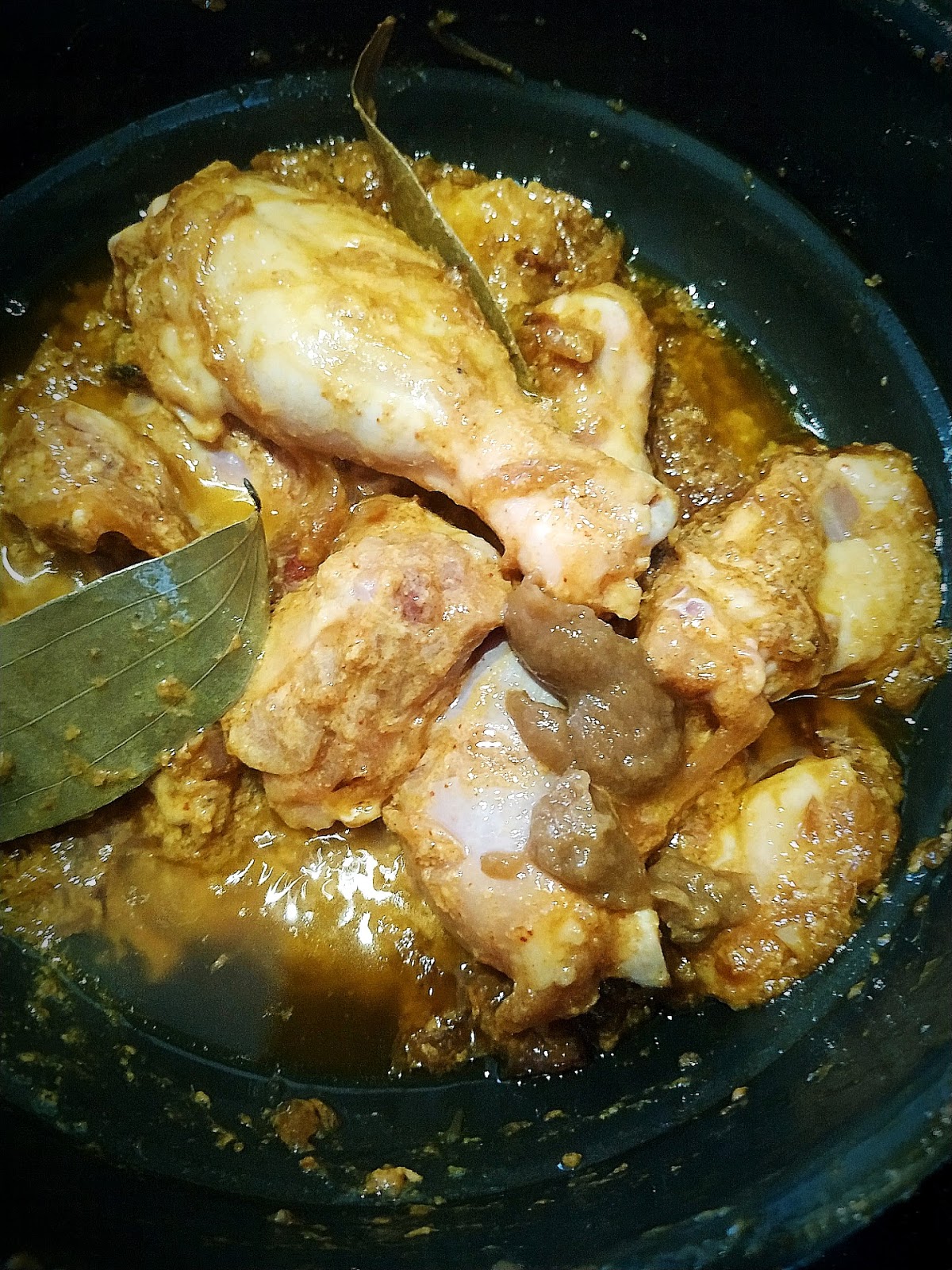

10. Cover and cook the chicken till it starts getting white or changes color. Keep turning the chicken frequently so that it doesn't stick to the wok.

11. Make a paste of poppy seeds and almonds.

Tip: This can be done two ways. Either dry roast the poppy seeds and the almonds and then grind to a paste. Or simply grind the raw poppy seed and almond into a paste. The first option would give a slightly nutty aroma to the chicken. I followed the first. 

Tip: If you don't have poppy seeds or almond, you can omit this step. Or if you have any one of them that is also fine. Almond can also be replaced with cashew.

12. Add the poppy seed and almond paste and fold in. You need to stir continuously to make sure it doesn't stick.


13. Boil the milk and keep ready. At this stage after mixing the nut paste add the milk and stir in. Cook the chicken with cover on till the chicken becomes soft.

Tip: The milk should be boiled and hot when it is added to the wok, otherwise it may curdle.


14. Chicken will start releasing water. Now cook till the water starts to dry off and the gravy thickens. At this stage add the sugar and fold in. Now keep the gas on sim and let it cook till the water evaporates and gravy becomes pretty thick. Make sure you stir the chicken frequently. 

15. Now follow the rice cooking procedure

16. Chicken should be nicely cooked by now. Switch off the flame and take out the chicken in a separate dish. 


17. Now continue with assembling of the rice procedure

Procedure (Preparing the rice): 

1. Take basmati or any flavored rice and wash it properly. Drain the water and keep it to dry. All water should be properly drained before we start cooking the rice. 

Tip: The amount of rice should be half of the weight of chicken. Since I had taken 500 gm chicken so I have taken 250 gm rice

2. When the chicken is almost done, we will start cooking the rice. Take another deep bottomed kadai and add heat it.

3. Add ghee and when it is hot add the bay leaf, cardamom, cinnamon. 

Tip: Again the pulao should be completely made in ghee to get the authentic flavor.

4. Now add the washed rice into the wok and keep stirring softly. Fry the rice till you feel it becomes heavy.


5. Now the water to cook the rice needs to be added. Water should be double the amount of rice. Which means 500 ml of water. Now instead of 500 ml of water, i have taken 3/4th water and 1/4th milk.  Make sure both milk and water are boiling hot when adding, this will quicken the cooking process. Add 1 tsp of salt and sugar to it and fold in everything nicely.


6. At this point the gas is on full and cooking without a lid while stirring regularly. Continue to cook till the water starts reducing and you can see the rice. Now lower the gas on medium and cover and cook till the water is absorbed and rice is 3/4th cooked. You can occasionally give it a gentle stir just to make sure all the rice is cooked. 

Tip: Take care not to stir vigorously because it will break the rice. Be very gentle while stirring.


7. While the rice is cooking go to step 16 of chicken.

Procedure (Assembly of the Pulao)

1. The rice should be 3/4th cooked and all the water should be absorbed by now. Take off the lid and switch off the gas. Now the chicken and the rice assembly will begin which will take some time so it is better to switch of the gas at this point.

2. Take off half of the cooked rice into a separate dish. 

3. Take the gravy from the chicken and spoon it over the rice. You can also mix it a bit. 

4. Now place the chicken pieces on the rice in a single layer. Take care while handling the chicken as it might break. Add the fried potato and boiled whole egg at this point. 


5. Now add the other half of the rice on top of the chicken and egg layer uniformly so as to cover the chicken completely.

6. Add a few raisins, slitted green chilli on top.

7. Sprinkle 1 tsp of rose water over the rice

Tip: For those who love the flavor of Kewra can add 1/4th tsp of kewra essence at this point. Personally I don't like it. 


8. Now cover the lid and if it has any steam outlet then block it with a clove. Put the gas on low and let it sit on dum for about 10 minutes.

Tip: If the wok doesn't have a heavy bottom then, the rice may stick, so just add a tawa below the wok so as to distribute the heat properly to the wok.

9. After 10 minutes, let the rice sit for about 5 minutes more before serving.

Gently mix the pulao before serving. have it just like that or with raita or any other non veg gravy side.

Do try this out and tag me (@curriesnstories07) on Instagram on your photos whenever you try the recipe and I will give a shout out to you.


Share
Tweet
Share
2 comments

Day 57 of Lockdown 

The week has been going much smoother now. I got my first big basket delivered groceries after two months yesterday. Though they are yet not delivering till your doorstep, but still delivering till the society gate is also good enough. 

Amidst the covid situation Bengal and Orissa had to battle out a new peril - the Amphan cyclone yesterday. Massive destruction happened all over. I can see my friends updating about their respective areas on the social Media. My mom who is now in Kolkata also described how bad it was for all those hours when the storm was raging. Most homes and apartments are inundated. Getting through the phone was also not easy as there is service disruptions all over. I cant even imagine what the poor folks are going through. Its just that somehow 2020 feels quite jinxed. We are days away from June and don't even know where half of the year disappeared. I just hope things become less taxing for us and we get time to recover from all that is happening.

The week has been super hectic for me in terms of office work. previously our office times used to be restricted to 9 hours. But now since we are working form home there is no boundary between work hours and personal time. Rather there is no personal time at all. From 9 it has gone up to 14 hours on an average daily. But we are not complaining much, as we all know we are grateful to have a job in these trying times.

Getting time to cook among all this is another challenge. So most of the time I do some pre-preps on the weekends for the week ahead. And in between just make something which is not labor intensive. Have had this nice Rohu eggs lying in my freezer for sometime now, so decided to make a quick batch of Macher dimer bora. 

Macher dimer bora/Fish egg pakoda/fish roe is a very popular food accompaniment in Bengal and are considered as a culinary delicacy. This is mostly prepared during the rainy season as during that time the fish have eggs. The most popular ones are the eggs of Rohu and Hilsa. The eggs are also sold separately for this two fishes.

For all the vegetarians or the rest of India, the concept of fish eggs might be very weird. I know this because once I was talking about macher dimer bora with my office colleagues most of whom belonged to central and western India and one of the guys was wide eyed when he learnt fish produce eggs 😂. As he overcame the shock, the next question he asked was how do you cook the fish eggs, make into an omelette with each egg? And I was at a loss of words. Then I thought, that's right, people who didn't have a clue as to how these things look will try to associate with the only thing we identify as eggs. When I explained to him the entire thing, he was like wow I learned something amazing today :). But this thing is not so rare. In fact we all know about a much more glamoured version of fish roe which is known as caviar. But that is very expensive, while the normal fish eggs are damn cheap. They come along with the fish at times.  I hope you enjoy this simple and quick recipe which peps up your weekday lunch.


Preparation Time : 10 minutes
Cooking Time: 15 minutes
Serving : 20-25 pieces

Ingredients :
  • Fish Egg - 1 cup ( I had Rohu)
  • Onion - 1 medium
  • Green Chilli - 2-3
  • Coriander Leaf - 1/4th cup, chopped finely
  • Ginger - 1/2 inch
  • Turmeric - 1/2 tsp
  • Red Chilli Powder - 1/4 tsp
  • Rice Flour - 1 tsp
  • Salt to taste
  • Mustard Oil 
Procedure: 

1.  Wash the fish eggs carefully under slow running water, so as to not wash away all the eggs along with the water. Drain the water and keep it in a mixing bowl.

Note: The fish vendors usually separate the fish egg pouch and give it to you separately. 

2. Chop the onion and chilli and add it the to bowl. Add grated ginger root and chopped coriander leaves. Add turmeric, salt, rice flour and chilli powder. Mix everything well. It will look like a thick cake batter

Tip1: It is always better to use your hand for mixing this, as doing it with a spoon might leave lumps. However do not squish the eggs, gently break the membrane with fingers and allow the egg to mix with the rest of the ingredients.

Tip 2: Question is how to measure the salt here as u would not like to taste the raw batter. So what I do is, I add salt a little less than i feel is required for the batter amount. Then fry a tiny pakoda and taste it. If salt is less in the fried version then i add the salt as needed.

Tip 3: Rice flour is added to make a crispy pakoda. A few suggest to add gramflour or besan but I feel that tampers the taste of the pakoda.


3. Heat oil in a frying pan. We are going to shallow fry the egg pakodas on medium flame. Now once the oil is hot, take spoonfuls of this mixture and put it on the pan, just in the shape of pakodas. Let one side cook till they are a little browned then flip and repeat the process.

Tip 3: If you are not sure whether the pakodas are cooked to the core, fry one pakoda break it in the middle and it should not be runny inside, but totally cooked. If you find it still soft then increase the frying time. Also you can cover and fry that will lower the cooking time.


4. Drain excess oil on a kitchen towel and serve

Serve it as a side with rice and dal or it also makes up for a good snack item.

Do try this out and tag me (@curriesnstories07) on Instagram on your photos whenever you try the recipe and I will give a shout out to you.


Share
Tweet
Share
2 comments

Day 54 of Lockdown

Putting every speculation to rest most essential and non essential items are now open from today. Amazon is showing delivery dates for my pincode again. Big Basket is once again having more than 5 open slots in the day. Vegetables and household stuffs are trickling back on online stores. I can see quite a few auto on the road. And it says that taxis will also be allowed to ply. Most surprisingly Spas and barber shops have been declared open. No matter how essential grooming is, I believe some of us will still prefer to hold back for a bit more time as a precautionary measure.

Till day before yesterday when non essentials were not allowed to be sold, I was thinking that the moment lockdown is lifted on non essentials I am going to get a binocular. Dont get me wrong, I do not intend to snoop on anyone or anything. Its just that the vista before my balcony is very amazing. There is a whole Mango orchard below. Behind that is acres of farmland where I can see farmers planting and harvesting their crops. After that a few societies and beyond those lies a series of rolling hills which are turning green now due to the frequent rains. And would you believe if I say I can also see the twin towers on Sinhagad fort very clearly form my balcony? Puneites would know what I am talking about. For the other, it is the famous Kondhana fort which Tanhaji Malusare reclaimed from the Mughals (refer to Tanhaji movie). In usual times we could only see the twin towers form my home post rains when weather cleared up. But now with pollution gone I can see it throughout the day. And even at night I can make out the lights. So while in this lockdown I realized there was a lot many things in front of me which I wanted to observe closely, the farming activity being the main interest. Hence the binocular idea. I think I had a more exhaustive list as well - like getting some empty canvases for painting, some notebooks for taking office notes, coconut powder - yes because coconuts have really vanished from the market in lockdown and many such things. 

Today when I realized that non essentials are now available I didn't look for any of those mentioned above, instead I looked up for books, story books and finally ordered a collection of Kakababu stories. He is a famous fictional sleuth character created by Bengali author Sunil Gangopadhyay, that has attained legendary stature particularly in Bengali literature. He is only next to Feluda in terms of popularity, another iconic sleuth character by Satyajit Ray. I am a sucker for detective stories and lockdown made me realize I am so sort on good books to read. I affectionately looked at the screen of my phone once the order was successfully placed. Nothing makes you more happy than the anticipation of a book being delivered.


Two more nice things happened in the day - one my neighbor made some chocolate pastries and offered them to me. I went over to her place to get them and she invited me over to a cup of chai. I had anyway missed my evening tea due to getting stuck in a meeting. I chatted for long with she and her husband and it was ages after which I actually visited anyone's place. Precisely 60 days I believe. It was a good relaxed evening spent over chai and stories. The second good thing happened was when Sinchita posted about trying out my Lau Fish curry recipe. Everytime someone tells me they made something from my recipes I feel a whole lot humbled and very very happy. It means a lot to me. It means I could make a small difference with my food. I feel special happiness documenting my food journey, because its not just recipes but I try and capture a few moments of the day, some event, something that touched my heart, a memory from older days, people who let some impression, places which made me smile and the likes. And yes also to talk about some of the recipes I grew up eating from my Grandma or mom and still in love with them. Had it not been for the lockdown many of us now a days dont cook themselves. I can understand working full time and cooking can be tedious. But somehow once I discovered the joy of cooking I was very much hooked to this. I never had a cook in my life so far, and I feel I want to keep it that way forever. But with less of us cooking, the recipes of our grandma and mothers might one day get lost in the folds of time. The very thought of which makes me melancholic. This was the very driving factor behind the creation of this blog a decade earlier. I wanted to note down these recipes somewhere on the internet where they wont be lost and may occasionally end up helping a few folks on their gastronomic journey. Whether I get to know or not, I will still feel happy if anyone tries these out and finds them good.

Today I am going to talk about Beet greens. Now this was a very recent find actually. So some 3-4 months ago one day, I picked up a bunch of beets with their greens attached to them. I was in a hurry to get back home and I had asked the vegetable vendor to just stuff everything into my bag without discarding the greens. Once home i discovered that the saag or the greens which was there looked very nice and fresh. Mostly they were picked within a day. Mom was also here in Pune with me then. I told her keep the greens separately. She asked me what will we do with it. And I said we will make some stir fry like we do with normal red saags. I did say that but I had no clue how it might end up tasting. But nonetheless I did keep them and finally mom made them into a stir fry which tasted so amazing. Both of us were greatly surprised by how well it tasted. Mom even remarked that who ever thought that beet greens could also be eaten, mostly it is discarded everywhere. Thus we both discovered something nutritious and tasty.

During the second week of lockdown, I chanced upon some fresh beet greens again. I asked the vendor to give me the greens. She happy did so and even added some more greens discarded form some other bunch. I got back home and washed and washed those as per the sanitization norms and then made it into this beautiful medley which I hope you enjoy as well.

Preparation Time : 20 minutes
Cooking Time: 20 minutes

Ingredients :
  • Beet Greens - A bunch (from 4-5  beets)
  • Potato - 1 big
  • Aubergines (Brinjal) - 3-4 small
  • Garlic - 12-15 pods
  • Green chilli - 2-3
  • Kalonji - 1 tsp
  • Turmeric - 1/2 tsp (Optional)
  • Mustard oil
  • Salt and sugar per taste

Procedure: 

1.  Clean the greens and chop them medium fine.

2. In a pressure cooker add a cup of water and throw in the chopped saag. Cook it for a whistle and immediately open the cooker, drain the water and run the boiled saag under cold water to stop the cooking process.
Tip: The beet greens are a bit hard usually so in order to cook them faster and retain their color, its good to cook it for a whistle and later just add it to the wok for frying.

After boiling the greens this is how it should look like

2. Roughly bruise the garlic pods with the help of a mortar pestle. 

3. Dice the potatoes into small cubes and the Aubergine as well. Pieces should be nearly same size.
Tip: Keep the cut potato and the aubergines in water till its time to cook, to prevent them form turning black in contact of air

4. Take a wok and heat some oil. When oil is hot fry the potatoes till they are 3/4 cooked. Keep aside. Fry the aubergines also for a couple of minutes and keep aside.

5. Now in the same oil, when its hot temper it with kalonji, bruised garlic and slitted green chillies.

6. Add the fried potatoes

7. Add the boiled chopped greens and adjust the salt, sugar and turmeric.
Tip: If you don't want to mess with the reddish hue then avoid the turmeric totally. I wanted to add a little of it to enhance the green color. But I would recommend don't add too much of turmeric because it strips any saag of its nature flavor.

8. Cook without cover, so that green color of the saag is maintained. The greens were already cooked so wont take much time to get into the final shape. Adding saag to any vegetable makes the other vegetable get cooked much faster. So the potato will also be nicely cooked in some minutes.

9. Check if both potato is done. At this stage add the fried aubergines. Give it a nice toss for a couple of minutes and switch off the flame. That way we wont break the aubergines while mixing.

Serve it with rice and daal or chapati. 

Do try this out and tag me (@curriesnstories07) on Instagram on your photos whenever you try the recipe and I will give a shout out to you.


Share
Tweet
Share
No comments


Day 52 of Lock Down

Well I have kind of lost track of the number of days now. Tomorrow lockdown 3.0 ends and lockdown 4.0 beings in Maharashtra. Officially it says 52 days, but I have been holed up in my home since the first week of March. Back then I had decided to work from home just as a safety measure, because employees around my cubicle were either coughing or sneezing. Who knew the work form home would spill into May or even June and no idea how much more.

As I jot this down, it started to pour outside. Like literally it is stormy weather outside and coming down as cats and dogs. From past two days, right from the morning it is cloudy. And then post afternoon we are getting light or heavy spells of rain. I think we are already getting the pre-monsoons. Somehow I don't even know where the summer went this year. we are inching into June when the monsoons are about to start. We lost a complete season to the virus, something we might have never anticipated. But the good part is, nature transformed. Getting Kalbaishakhi in Pune was something unexpected. We also transformed. We learnt to do everything a bit differently and then improvised as well. Had not it been for the lockdown, I barely got time to invest in the blog. But now I am once again investing time in things I had put on backburner even after day's office work. It feels great. Cooking, writing, photography, painting and reading all sorts of interesting stuff on the net, plus making new friends and acquaintances in food forums. There is definitely a fear looming on us about the situation around, especially when we are stepping out of the home to make essential errands. But still we are learning to live with it and adapt. The journey has been interesting so far with a few hiccups as well.

 I had joined a few food groups in facebook much before the lockdown started. But I hardly spent time to check them out on a daily basis. When lockdown started, initially the time spent in looking at all I could find in facebook increased considerably. And I realized I was part of a food group names as Pune Food Group which had some amazing recipes published on a daily basis by its patrons. Watching all the amazing creations over there I felt inspired in true sense. Once the lockdown phase stabilized a bit, when we again started getting food essentials properly, I started investing a little more time in cooking dishes which I never tried before. Some of them were traditional Bengali recipes, some fusion, and some totally based on the ingredients available at any given day.

For the longest period in time I was missing getting fish. Being a Bengali its pretty unimaginable that I didn't eat any fish for over a month back then. Previously I used to get my fish supplies from local fishmongers and mostly it would be either Rohu, Catla or Magur. Because that's all I would get in my area which was aligned to my Bengali palate. Rest all were mostly the fishes which Maharashtrians preferred. Not many Bengalis live in this part of the town hence no Bengal specific fishes would come, apart from Hilsa which I would get at the nearby Big Bazar. But with the lockdown, there was absolutely no option of leaving this area, since all roads were blocked. One day to my utter joy I found a neighborhood fish store open. I wrote about the experience in my Sorshe Diye Macher Jhal blog. But then again when the soul is Bengali it can not thrive long on the Bangda and Kolambi selections alone.

So it happened that when I started posting about a few of my dishes in this FB group, I met a few folks with whom i built a good camaraderie and shared the usual fun banter. During one such instance I met Sinchita and we got talking over things including sourcing good fish in these times. That's when I got to know about Fresh to Home from her. Previously there was this one time I had bought fish online because I was not getting Catla locally and I need it for preparing curry for some guests coming over. But when it had arrived, I was utterly disappointed. Right form the packing to the contents everything was dismal. The fish was probably dead a month back and in freezer till then. The fish tasted like cardboard and I swore never to order fish online again.

But dire situations demand dire actions. So I thought I will give it a go again, especially since many members of the group were all praises for their service. Problem was that it was still the phase of lockdown 2.0 and my area came under one of the many containment zones of Pune. So whenever I was looking at the app it showed all empty. After trying for a couple of days I finally concluded that they were not servicing in this area at all. When I told this to Sinchita, she went out of her way and informed me when they were available. And I was able to place the first order. So just as a precautionary measure I ordered something else initially to gauge their quality. The delivery guy was dot on time and he was wearing all safety gears. I saw him sanitizing his hands before he touched the bag of products. The product is vacuum sealed and then put inside another packet and then the delivery guy puts it into a brown paper bag and hands it over to you. I pretty much liked what I saw. This is not a sponsored post or anything. I liked the services of Fresh to home and hence I wanted to mention it in here, so that if someone would just stumble upon my blog they might find this information useful.

After the successful attempt now I was ready to order my first fish from them. This week while just gazing the application I saw a fish that looked like Shol. I looked at it twice because Shol is something I never thought I would see anywhere outside Bengal. At least in the last decade in Maharashtra I never saw it, not even in Mumbai. When I was kind of convinced I thought its still better to double check with my mom, because the prices looked a bit steep. Immediately send a picture of it to mom who was as surprised as me and confirmed it was indeed Shol. My joys knew no bound as I ordered them. and they got delivered just on time the next day.


Shol is a fresh water fish with a firm flesh. They also known as shoal fish, channa striata, shoul fish, snakehead fish etc. Its a very popular fish in the eastern part of India, especially Bengal, Assam and Bangladesh. My first memories of this fish gravy was that prepared by my grandma when we used to visit her in vacations. She would make small pieces of the fish and that was my only gripe. I always wondered why she used to only make this particular fish into such small pieces. No way to know that now because she is no more. My best guess can be because of its firm texture, smaller pieces means better absorption of seasonings. Whenever I visit Kolkata, at least once mom would prepare this. I never realized I liked this fish this much until I saw it in the app and ordered even at Rs 200 extra per Kg than what it is in Kolkata.

The fish looked firm and pink and when I cooked it today , a day later it was still super fresh. I could tell it clearly by the way they looked when I fried them. Traditionally I prefer it with red pumpkins just the way my mom prepares. But during this lockdown I am not getting them. So next best option was lauki or lau. This is also a classic combination. Mainly this combination of fish with Vegetables might sound a bit weird to many, but its very common in the east, especially in the Bangal cuisine. A very simple and light gravy which has the goodness of both vegetables and fish making it a wholesome meal in one with rice.

Preparation Time : 15 minutes
Cooking Time: 20 minutes

Ingredients:
  • Shol Fish - 500 gm
  • Lau/lauki (Bottle Gourd_ - 1/2 Kg
  • Bay Leaf (Tej Patta)- 1 
  • Radhuni - 1/2 tsp
  • Jeera (Cumin) - 1/2 tsp
  • Green Chillies - 2-3 
  • Turmeric - 1 tsp + 1 tsp
  • Sugar - 2 tsp
  • Salt as required
  • Mustard oil


Procedure: 

1.  Clean the fish and marinate with salt and turmeric. Drizzle it with a little oil, it helps in coating the fishes with the spices better. 

2. Fry the fish in mustard oil and keep aside
Tip: For frying fish Bengalis always prefer Mustard oil, because it cuts through the fishy smell better than refined oil


3. Peel off the skin from a Lau. Cut the lau into half rounds.
Tip: You can preserve the lau skin and make it into a nice bharta. Will share the recipe sometime.

4. Take some water in the pressure cooker like 2 cup and transfer the lau into it. Add a spoon of sugar to it. Now put the lid on and cook it for 1 whistle. 
Tip: Sugar helps retain the green color of the lau even when pressure cooked.


5. Immediately remove the pressure cooker and let it stand under the tap water for a few seconds before the pressure dies and open the lid. Drain the hot water and run the lau once under normal tap water to stop further cooking process due to heat. Preserve the water separately. It will be used for the gravy base.
Tip: If you immediately open the lid of the cooker then it also helps in retaining the color. The longer it sits in the hot water, the sooner it looses the color


6. Take a wok, and heat Mustard oil. When oil is hot throw in a spoonful of jeera. Fry it for 30 seconds and take them out with a spoon into some plate. Let them cool down while you do the rest of the cooking.
Tip: Don't use iron wok for cooking Lau, it will strip off the green color and darken the  dish


7. Temper the same oil with Bay leaf, slitter green chillies, cumin and radhuni. 
Note: If you do not have radhuni, only jeera should also be fine.


8. Add the boiled lau and add turmeric and salt.


9. Add the Lau stock to it about 1 and a 1/2 cups. Fold every thing in.
Tip: Add the water as per your liking. Lau curries don't work with too much of gravy. It tastes best when the gravy is less.


10. Add the sugar. Now this is an essential step in a lau gravy to balance the taste. You can vary as per liking. If you want to omit it totally that should also be fine, but I feel it tastes much better with some sugar.
Note: Sugar is added only to balance the taste, gravy is not supposed to be sugary sweet.

11. Add the fish pieces now. And stir everything in.


12. Boil it for about 5- 10 minutes till the fishes start releasing their juices into it. If you want to dry off the extra water, do that in this stage.

13. Crush the fried jeera you had kept aside at step 6. No need of fine grinding. Just crush enough so they release the flavours.

14. Once the fish is cooked int he gravy, sprinkle this crushed jeera on it and cover it. Let the aroma of the fried jeera mix with the gravy till its time to serve.

Serve it with steamed rice.

Do try this out and tag me (@curriesnstories07) on Instagram on your photos whenever you try the recipe and I will give a shout out to you.


Share
Tweet
Share
No comments
Newer Posts
Older Posts

About me

I am a software engineer by profession and a writer at heart. Born and brought up in Kharagpur, I moved to the city of dreams Mumbai when I got my first job. Till then I had not cooked a single dish in my life. Not even Maggi or tea. My dad had a strong belief that his little princess never will be in a situation where she had to cook for herself. Hence I was not allowed to spend time in the kitchen till I was studying.


So when I faced the daunting task of living alone, dabbas came to initial rescue. After that I managed a whole year on just boiled vegetables and rice. And then I landed in US. The bounty of fresh produce and cooking ingredients available in the super marts eventually lured me into making my very first meal ever. There was no turning back after that. I finally discovered how much I was in love with cooking and being creative in the kitchen.


This blog is a humble attempt to present our culinary heritage to one and all and document some of the very traditional recipes which gets passed on through generations just by word of mouth.


So just sit back with a cup of tea or coffee and enjoy the curries and the stories related to each.


Follow Us

Footprints

Blog Archive

  • ▼  2026 (4)
    • ▼  May (1)
      • A Suitcase Full of Stories: My Heartfelt Shopping ...
    • ►  January (3)
  • ►  2025 (3)
    • ►  December (1)
    • ►  June (1)
    • ►  February (1)
  • ►  2024 (21)
    • ►  December (2)
    • ►  September (1)
    • ►  August (3)
    • ►  July (4)
    • ►  May (2)
    • ►  April (5)
    • ►  March (3)
    • ►  January (1)
  • ►  2023 (7)
    • ►  December (2)
    • ►  November (1)
    • ►  October (1)
    • ►  May (1)
    • ►  March (1)
    • ►  January (1)
  • ►  2022 (18)
    • ►  September (1)
    • ►  August (2)
    • ►  July (2)
    • ►  June (3)
    • ►  April (1)
    • ►  March (3)
    • ►  February (2)
    • ►  January (4)
  • ►  2021 (60)
    • ►  December (5)
    • ►  October (5)
    • ►  September (5)
    • ►  August (7)
    • ►  July (6)
    • ►  June (5)
    • ►  May (3)
    • ►  April (4)
    • ►  March (6)
    • ►  February (6)
    • ►  January (8)
  • ►  2020 (55)
    • ►  December (5)
    • ►  November (3)
    • ►  October (10)
    • ►  September (7)
    • ►  August (7)
    • ►  July (9)
    • ►  June (3)
    • ►  May (9)
    • ►  March (1)
    • ►  January (1)
  • ►  2019 (3)
    • ►  November (1)
    • ►  April (1)
    • ►  January (1)
  • ►  2018 (1)
    • ►  December (1)
  • ►  2017 (4)
    • ►  December (2)
    • ►  November (1)
    • ►  September (1)
  • ►  2016 (10)
    • ►  August (1)
    • ►  July (2)
    • ►  June (5)
    • ►  April (1)
    • ►  March (1)
  • ►  2015 (10)
    • ►  December (1)
    • ►  August (1)
    • ►  June (1)
    • ►  May (2)
    • ►  April (4)
    • ►  March (1)
  • ►  2014 (22)
    • ►  November (2)
    • ►  August (2)
    • ►  July (3)
    • ►  June (2)
    • ►  May (4)
    • ►  April (3)
    • ►  January (6)
  • ►  2013 (22)
    • ►  November (2)
    • ►  October (4)
    • ►  September (5)
    • ►  August (2)
    • ►  July (1)
    • ►  June (1)
    • ►  May (2)
    • ►  April (1)
    • ►  March (1)
    • ►  February (2)
    • ►  January (1)
  • ►  2012 (31)
    • ►  December (4)
    • ►  October (3)
    • ►  September (8)
    • ►  July (1)
    • ►  June (1)
    • ►  May (14)
  • ►  2010 (9)
    • ►  July (3)
    • ►  June (2)
    • ►  April (1)
    • ►  March (2)
    • ►  February (1)
  • ►  2009 (4)
    • ►  February (2)
    • ►  January (2)

recent posts

Pinterest Board

Popular Posts

  • Champaran Mutton / Ahuna Mutton - A Bihari Delicacy
      When I finish a long week of work, self doubt, frustration of dealing with people and finally when the weekend comes, I feel cooking somet...
  • Khandeshi Kala Masala - Kala Mutton Masala
      25 September Maharashtra is a land of unique local flavours. And still it is mainly known for its Vada Pavs, poha, pav bhaji and modaks. I...
  • Kochur Dum / Kochur Dalna / Arbi Masala/ Taro or Colocasia Curry
    August 19 Kochu or taro is one of my favorite vegetables. It is as versatile as potato only much more tasty. It is equally starchy an...
  • Tetor Macher Jhol (Bitter Gourd Fish Curry)
    Anything Bitter hardly finds takers. Same applies for Bitter Gourd. As a kid I hated bitter gourd in any form. Grown ups around me would...
  • Macher Bhorta | Fish Bharta | Mach Makha| Bengali Style Mashed Fish
      October 18 Bhortas or bharta as we call it in pan India, are the quintessential Bengali food, a staple in Bangladeshi cuisine. They are th...
  • Complete Details to plan your ISKON Mayapur Visit
    Radha Madhav during Pushya Abhishek on 6th Jan 2023 First of all wish you a very happy new year. I have been away from blogging for a while ...
  • Kumro Phool bhaja (Pumpkin Blossom fritter) and a Jade trip of Konkan in rains
    Rains , Lush green forest laden mountains, Cascading milky white waterfalls, cloud filled valleys, Turbulent coastlines,...
  • Varhadi Mutton - A Traditional Vidharba Cuisine
    Varhadi is a dialect of Marathi typically spoken in Vidarbha region of Maharashtra. Vidarbha is the north-eastern region of Maharashtra ...
  • Golda Chingri Malaikari (Giant River prawns in coconut milk gravy)
    One of the main reasons I love Kolkata is because of the fish we get here. Its so fresh and one can get restaurant grade fish quality even i...
  • About Slow Travel | Spice2Nuts - a spice initiative by Harish Bali (Visa2Explore)
    Moments from my travels - 1. Forest in Meghalaya 2. An old boat in Shnongpdeng 3. Fish Mint 4. Local Cinnamon  Traveling has always been a p...

Liebster Award

Liebster Award

Very Good Recipes

Very Good Recipes

You can find my recipes on Very Good Recipes

Contact Us

Name

Email *

Message *

Pages

  • Travelogue Index
  • VEGETARIAN RECIPE
  • CHICKEN RECIPES
  • SEAFOOD RECIPES
  • MUTTON RECIPES
  • RICE RECIPES
  • EGG RECIPES
  • DAAL RECIPES
  • ROTI & PARATHA RECIPES
  • BAKING RECIPES
  • SWEET RECIPES
  • SNACKS RECIPES
  • SIDES RECIPES
  • SOUP RECIPES
  • SALAD & BOWLS RECIPES
  • ROASTED RECIPIES
  • JAM & PRESERVE RECIPES
  • BEVERAGE RECIPES
  • SAUCES, SPICES & CURRY BASE RECIPES
  • CHUTNEY & DIPS RECIPES
  • FESTIVE RECIPES
  • Contact Us
  • TRAVELOGUES OF EAST INDIA
  • TRAVELOGUES OF WEST INDIA
  • TRAVELOGUES OF SOUTH INDIA
  • TRAVELOGUES OF NORTH INDIA
  • TRAVELOGUES of ASIA
  • North East Recipe

This Blog is protected by DMCA.com

DMCA.com for Blogger blogs
FOLLOW ME @INSTAGRAM

Curries n Stories © 2020 All rights reserved.
Created with by BeautyTemplates